
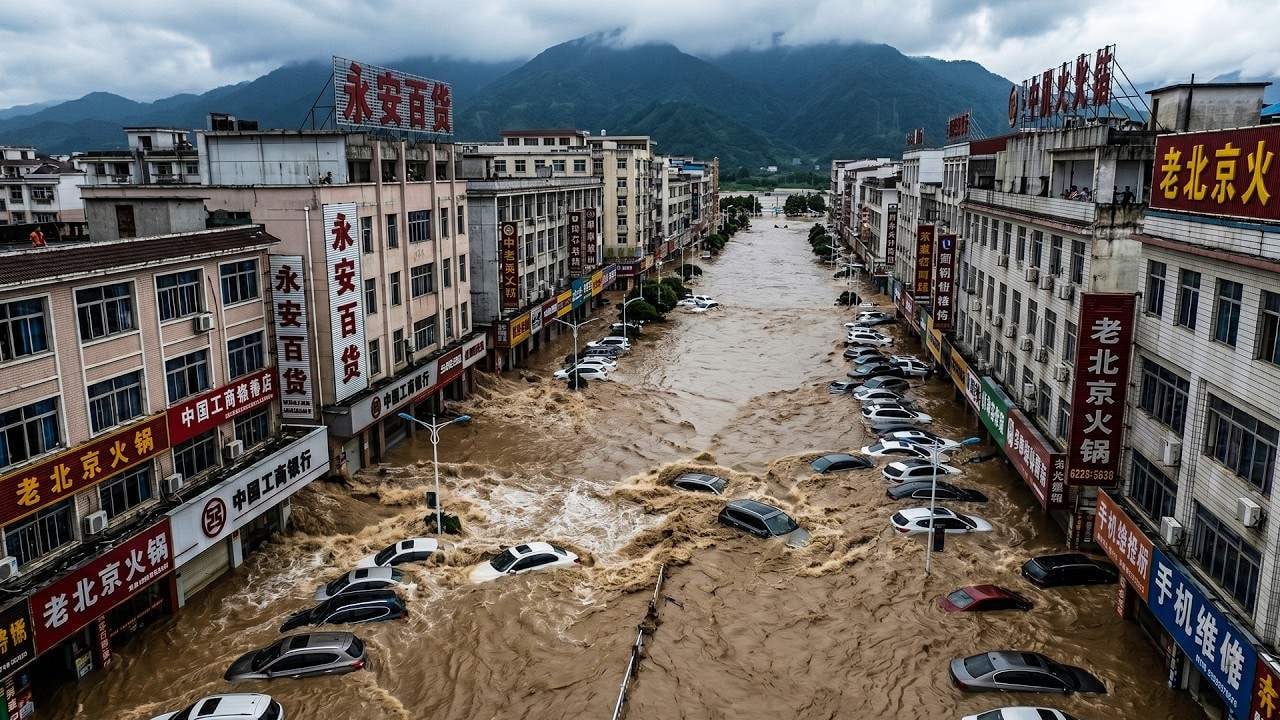
In the second half of May, China came under the influence of several dangerous natural processes at once. In different parts of the country, heavy downpours, floods, landslides, and seismic activity were developing almost simultaneously.
One of the most notable events was a pair of shallow earthquakes in the Guangxi Zhuang Autonomous Region. On May 18, two tremors of the same magnitude — 5.2 — were recorded in the Liunan District of Liuzhou. The first earthquake occurred at 12:21 a.m., and the second at 9:44 p.m. local time, about 21 hours apart. Both hypocenters were very close to the surface, at depths of up to about 6 miles.
According to the China Seismic Network, the epicenters were located about 0.6 miles apart. At the same time, the area proved to be extremely vulnerable: up to 6.8 million people live within a radius of about 62 miles from the epicenters.
Seismologists described the activity as an earthquake swarm. The tremors had begun a full day before the two main earthquakes on May 18, and after them, a series of aftershocks continued, the strongest of which reached a magnitude of 3.6.
The consequences also affected the regional economy. In Liuzhou, a popular tourist area known for restaurants serving luosifen — a local spicy rice noodle dish — was damaged. After the earthquakes, tourist sites were closed, and some residents and visitors tried to leave the area as quickly as possible.
For Guangxi, this event became one of the most severe in terms of consequences among earthquakes of comparable magnitude in recent years.
According to official data, at least two people died, and nearly ten thousand residents were evacuated.
However, seismic activity was only part of the broader picture.
Since mid-May, central, southern, and southwestern China have been hit by a series of extreme rainstorms. The provinces and regions affected by downpours, flash floods, landslides, and mudflows included Hubei, Hunan, Guizhou, Guangxi, Guangdong, Chongqing, Jiangxi, Anhui, Sichuan, Shaanxi, and others.
In Guangdong Province, on May 20, the hydrological station in Hekou Township, Yangjiang County, recorded 39.4 inches of rainfall in a single day, while the average monthly rainfall for May is 10.7 inches.
In Hubei Province, the scale of the rainfall was also exceptional: historical records were exceeded at 112 weather stations. The situation was especially severe in Baishuihe Village, Enshi County. Local residents said the rain continued almost without stopping for about a full day, and the flood peak came at around 4 a.m. on May 18. In some places, the water rose to about 13 feet.
The flood damaged roads, communication lines, and power supply systems, effectively complicating access to the village. In Shimen County, Hunan Province, the disaster affected more than 58 thousand people. Water flows caused bridges to collapse, while more than twenty mountain villages in the Hupingshan area were left without electricity or communications. Humanitarian aid had to be delivered there by drones.
Another powerful blow struck Chongqing. On the night of May 24, 296.6 millimeters — or about 11.7 inches — of rain fell in just two hours in Yongchuan District. This was more than twice the average monthly May rainfall for this area, which is 120.2 millimeters, or about 4.7 inches. Later that same day, a mudflow destroyed several residential houses. There were fatalities, and some people were listed as missing.
One rescuer described a man who managed to run out of his house during the landslide but was knocked down by the flow of water. He managed to cling to a tree. Later, he was found alive, but he had suffered a fracture and was severely weakened.
By May 25, water levels in ten small and medium-sized rivers in China had risen above warning levels.
As of May 20, floods and landslides in China had killed at least twenty-two people, while another twenty were listed as missing.
The events in China showed how dangerous the situation becomes when different natural hazards develop almost simultaneously. These are precisely the kinds of anomalies that reveal how natural systems are changing and which threats may come to the forefront in the coming years.
Understanding the physics of these processes is becoming the key to making sense of the ongoing changes, which are increasingly affecting everyone. That is why a scientific approach to studying the transformations taking place on the planet is now becoming one of the priority tasks for society as a whole.
Publication of this material provides an opportunity for open discussion and does not in itself imply institutional endorsement, confirmation, or scientific verification of the views expressed. The material does not constitute an official statement, expert opinion, or professional advice.