
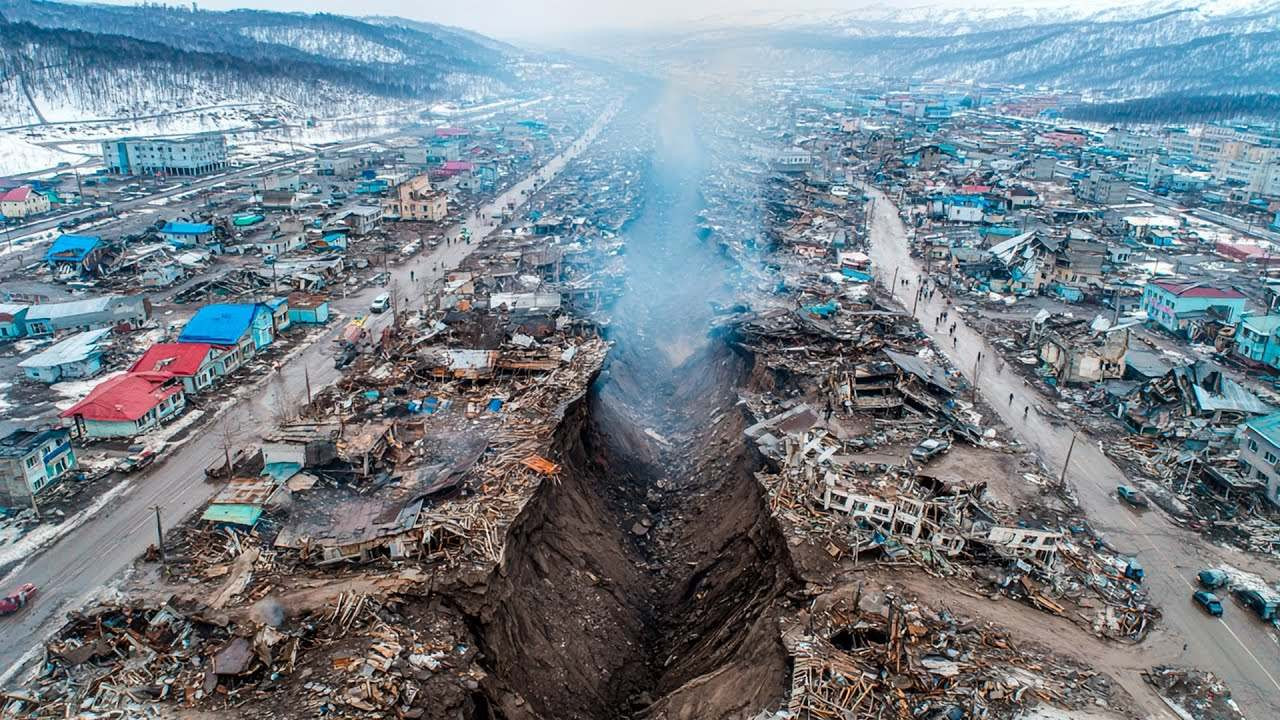
The magnitude 8.8 earthquake that struck Russia’s Kamchatka Peninsula on July 30 has entered the list of the six most powerful earthquakes in modern planetary history. The epicenter of the seismic event was located approximately ninety-two miles from the regional capital, Petropavlovsk-Kamchatsky, and the hypocenter was at a depth of about eleven miles.
Danila Chebrov, Director of the Kamchatka branch of the Unified Geophysical Service of the Russian Academy of Sciences, described the quake as “an event of planetary scale.”
Even for the people of Kamchatka — long accustomed to seismic activity — this earthquake was a shock. According to eyewitnesses, the shaking lasted more than three minutes. The tremors were felt across the entire peninsula: buildings swayed, construction cranes rocked, furniture toppled inside homes, and cracks appeared in walls. In the Yelizovo District, the facade of a kindergarten collapsed, and buildings of the Kamchatka State University and the local airport suffered structural damage.
According to the Ministry of Health, there were injuries: many people were hurt while fleeing buildings, and some even jumped out of windows. Emergency services were overwhelmed with calls — people reported sudden spikes in blood pressure, arrhythmia, epileptic seizures, and panic attacks.
In just the first twenty-four hours after the main quake, nearly one thousand aftershocks were recorded, with magnitudes reaching up to six point seven, striking every few minutes. More than five thousand people were evacuated to safer zones. A tsunami warning was issued almost immediately. In the Yelizovo District of Kamchatka, wave heights reached ten to thirteen feet, and on the Kuril Islands, waves rose up to sixteen feet. In Severo-Kurilsk, water surged over six hundred and fifty feet inland, flooding the port and damaging local fisheries. A scientific expedition camp on Shumshu Island was also inundated.
The threat of a tsunami spread rapidly across the Pacific region, prompting urgent responses from authorities in Japan, China, the United States, Indonesia, Chile, Peru, and Ecuador. In Japan’s Hokkaido Prefecture, wave heights reached approximately four feet three inches. On Hawai‘i, they rose as high as five feet seven inches. In Chile and Peru, waves measured between twelve and sixteen inches.
Mass evacuations from coastal lowlands began immediately. In Japan, about two million people were forced to leave their homes. Rail service was suspended, and Sendai Airport was temporarily closed. In Chile, authorities launched one of the largest evacuations in the country’s history: according to the Ministry of the Interior, one million four hundred thousand people were moved to higher ground. On Hawai‘i, traffic jams stretched for miles, harbors were shut down, and flights were canceled. In the United States, tsunami waves reached the coasts of Washington, Oregon, California, and Alaska.
Meanwhile, the Klyuchevskoy volcano began erupting. Molten lava streamed down its western slope, and bright glow and explosions erupted above the crater. Volcanologists in Kamchatka directly link the activation of Klyuchevskoy to the powerful earthquake.
Earth is now entering a new phase of heightened seismic activity — a period of catastrophic earthquakes that, unfortunately, can no longer be avoided. In one of his recent addresses, Dr. Egon Cholakian outlined the geological processes already underway and what they are likely to lead to in the near future.
But this is more than just a forecast. He also presented practical solutions that can help mitigate the unfolding chain of natural disasters — including unique technologies developed by the ALLATRA scientific community.