
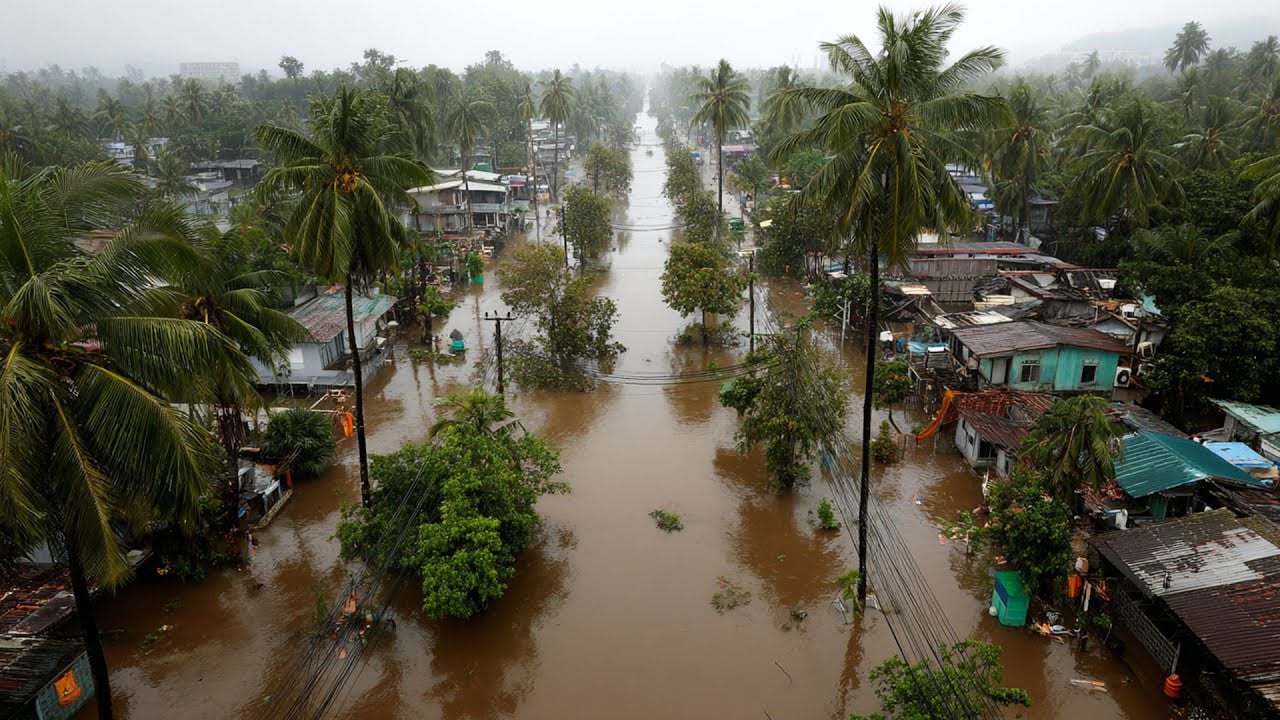
The relentless torrential rains that struck southern Thailand led to a large-scale disaster in ten provinces at once. More than two million seven hundred thousand people were affected, and about forty-five thousand residents were forced to urgently evacuate. Due to the flooding of railway tracks, the state railway temporarily suspended train service in the southern direction, and hundreds of tourists found themselves blocked in hotels and at airports, unable to leave the disaster zone.
On November 25th, a state of emergency was declared in the country. The army, helicopters, and even the only aircraft carrier in Thailand were deployed for rescue operations; together with a flotilla of fourteen boats, it was sent to assist the victims.
The most severe situation developed in the Hat Yai district of Songkhla Province — the most powerful flood in the past twenty-five years occurred here. The city, which is a major business and tourist center, was hit by record rainfall: at Hat Yai Airport alone, within twenty-four hours — from the morning of November 21st to the morning of November 22nd — 14.7 inches of rain fell.
The water level rose to eight point two feet. Many people spent several days on the roofs of their homes without water or food. Huge snakes were floating along the flooded city streets, adding even more terror to the chaos.
The main hospital of Hat Yai was also submerged, where at that time there were six hundred patients, including fifty people in intensive care.
Helicopters were used to deliver food, fuel for generators, and to carry out the emergency evacuation of critically ill patients. Thirty newborns were also in mortal danger when water flooded the two lower floors of the building.
The rampaging elements claimed the lives of thirty-three people. Most of the victims drowned or died from electric shock.
The cause of this flood was not a tropical cyclone, as is usually the case in the region, but a stationary low-pressure zone that triggered a rare and extremely dangerous phenomenon — the so-called “rain bomb,” when a colossal volume of precipitation falls within a short period of time, comparable in destructive force to a powerful hurricane.
The development of events was predicted only two hours before the impact of the elements. Moreover, the main blow occurred late at night, when residents had practically no time for either preparation or evacuation.
Such a catastrophic development of events, not only in tropical countries but throughout the entire world, had been forecast by scientists of the international scientific collective ALLATRA several decades ago.
Unfortunately, at that time, the global public ignored this warning. And in the coming years, many scientifically grounded scenarios of what will happen with cataclysms on Earth were voiced. We invite you to read this report, as understanding what is happening can save your life.