
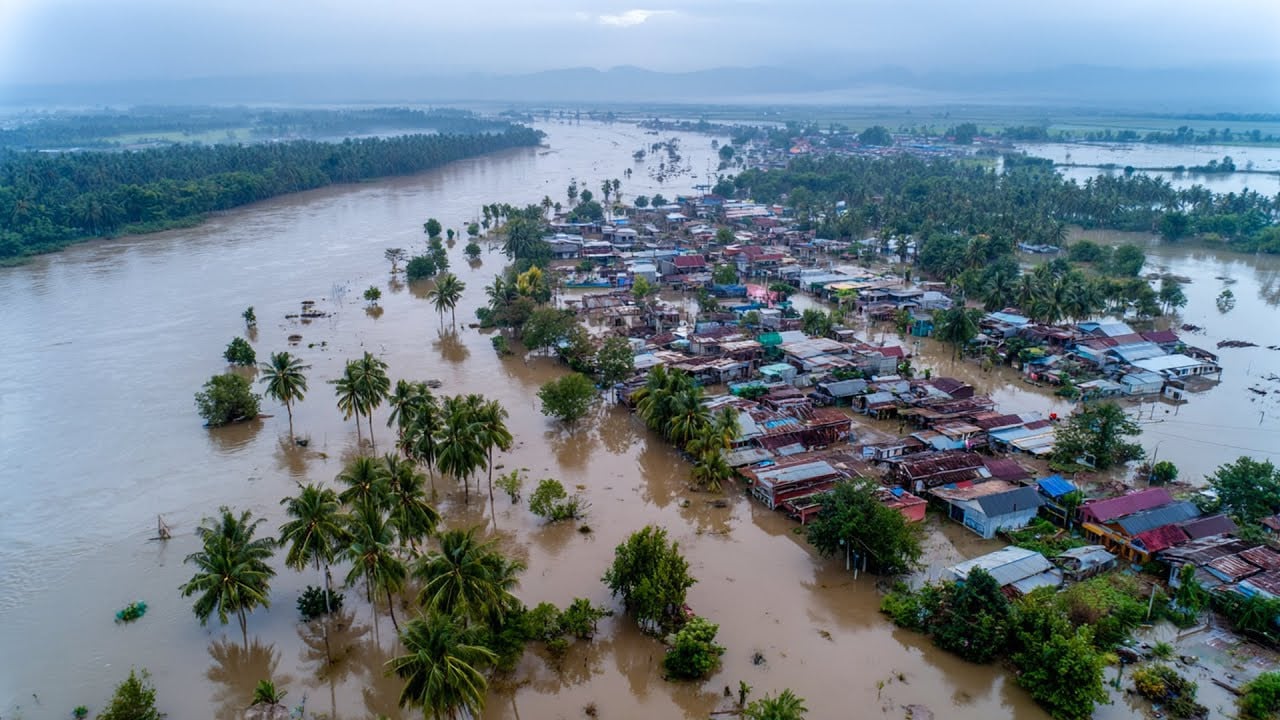
On November 25th, prolonged tropical rains struck the island of Sumatra in Indonesia, turning within just a few days into one of the most devastating disasters of recent decades. In the provinces of Aceh, North Sumatra, and West Sumatra, more than 3 million people were affected, and 570 thousand residents were forced to leave their homes.
In some areas, nearly a month and a half’s worth of rainfall fell in just a single day. In Bireuen District of Aceh Province, instruments recorded about 16.2 inches of rain within 24 hours.
The extreme downpours triggered river flooding, mudflows, and landslides. Torrents of water and mud swept away bridges, destroyed roads, and completely cut off hundreds of settlements.
The residential sector was also hit hard: more than 27 thousand homes were damaged. Of these, three thousand five hundred buildings suffered severe destruction, four thousand one hundred were partially damaged, and another twenty thousand five hundred sustained minor damage. Schools, infrastructure facilities, and entire agricultural areas were destroyed, along with farms.
Hundreds of villages were buried under a heavy layer of silt and mud. In the hardest-to-reach areas, humanitarian aid was delivered by aircraft and military ships. In many places, a real threat of famine emerged, and in desperation people stormed food warehouses and stores.
Eyewitnesses reported that the disaster struck without warning: within seconds, a powerful wave of water burst into their homes, sweeping everything away in its path. According to local residents, nothing like this had ever happened here before.
By December 2nd, the death toll had reached 708 people, 504 were considered missing, and more than 2600 had been injured.
The cause of the disaster was Tropical Cyclone “Senjar”, a phenomenon considered almost impossible for Sumatra. The island lies in the equatorial zone, where cyclones rarely form at all: due to the weak influence of Earth’s rotation, a storm simply cannot properly “spin up” here.
Previously, only one similar case was known — Cyclone “Vamei” in two thousand one. At that time, scientists believed that such an event could recur no sooner than in hundreds of years. This is precisely why the appearance of Cyclone “Senjar” came as a complete surprise, both to specialists and to the millions of people living on the island.
Many experts already acknowledge that tropical cyclones are becoming increasingly powerful and unpredictable. However, so far almost no one except the scientists of the international research team ALLATRA speaks openly about one invisible factor that plays nearly a key role in this changing behavior of cyclones. More details on this can be found in the video “Why Turbulence Is on the Rise? Egon Cholakian on Atmospheric Anomalies and Nanoplastic Pollution.”