
The storm “Claudia” developed from a broad area of low pressure that had already brought early cold weather and snowfall to eastern Canada and the northeastern United States in early November. As the system moved over the Atlantic, it strengthened, and after slowing down to the northwest of the Iberian Peninsula, it began accumulating enormous masses of warm, humid air.
Beginning on November 11, the Spanish region of Galicia was hit. Within a single day, up to 5.9 inches of precipitation fell, and such volumes of water turned city streets into rushing torrents. Rivers, overwhelmed by the sudden inflow, began overflowing their banks, creating a flood threat for nearby settlements.
In Portugal, “Claudia” struck with particularly destructive force.
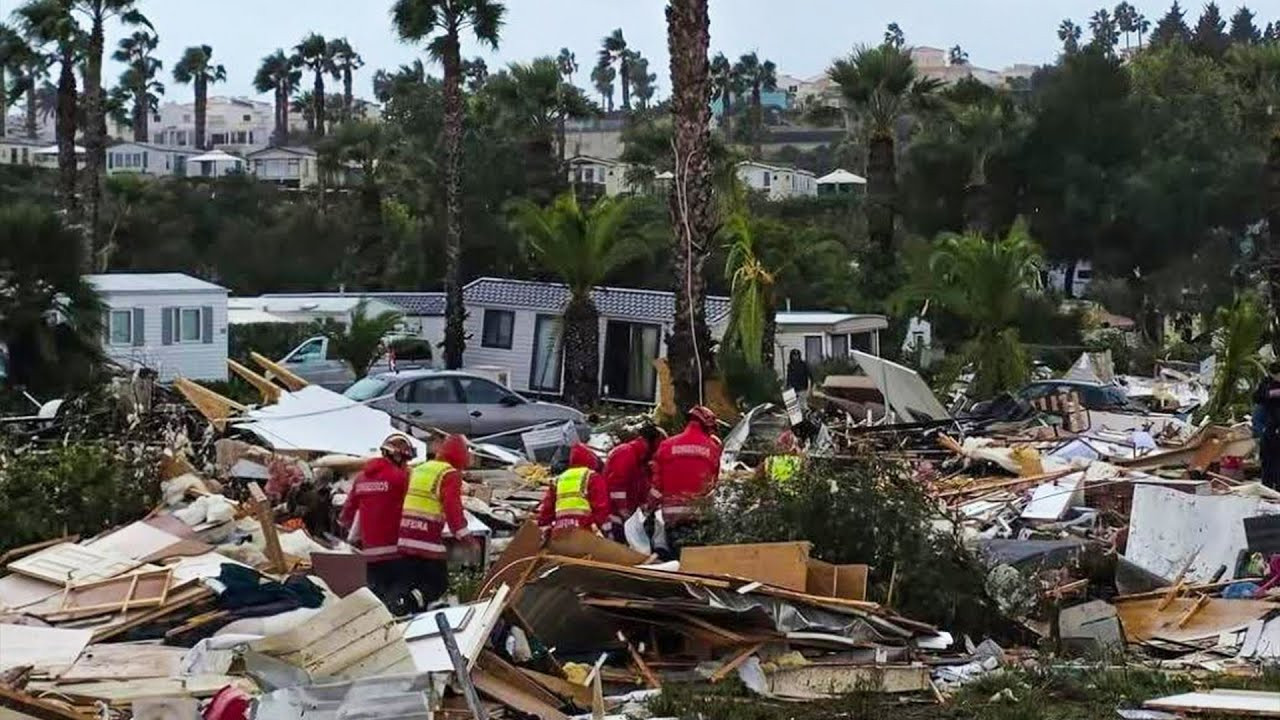
The most dramatic events unfolded in the popular tourist city of Albufeira, located in the southern region of the Algarve. It was here that a tornado formed in the morning: the vortex hit a hotel restaurant at the moment when several dozen people were having breakfast inside. The tornado’s destructive power left 28 people injured, including six children between the ages of two months and seven years. Four adults with serious injuries were hospitalized. The tornado also tore through a campsite, where a woman was killed while inside her motorhome when the storm struck.
On November 15, another tornado hit the municipality of Silves, where several buildings were destroyed and two residents were left homeless.
In Faro District, wind gusts reached approximately 69.6 miles per hour. Torrential downpours combined with hurricane-force winds toppled dozens of trees, damaged power lines, and caused widespread electricity outages.
In the village of Azeitão, located in the municipality of Setúbal, a landslide collapsed a section of road. Traffic was completely blocked in both directions, significantly complicating the work of emergency services.
In the town of Fernão Ferro, located near Lisbon, water levels rose so rapidly that during the night, it burst into the home of an elderly couple. They were unable to escape and drowned.
The scale of the storm’s impact across the country was enormous: according to the National Authority for Emergency and Civil Protection (ANEPC), three thousand three hundred sixty-three incidents directly related to the severe weather were recorded throughout Portugal.
As it moved farther north, “Claudia” reached the United Kingdom. In England and Wales, the situation was worsened by sudden flooding. In the town of Monmouth, nearly four point seven inches of rain fell overnight, exceeding the average monthly rainfall. The River Monnow breached its defensive structures, and on the morning of November 16, residents found most of the town submerged. In southern England, several railway lines were closed — both due to fallen trees on the tracks and the high water levels.
Ireland fared no better. The counties of Wexford and Laois were hit hardest. A sharp rise in river levels led to the flooding of homes and businesses, and about five thousand people were left without electricity, according to ESB Networks.
In France, however, the same storm produced a completely different yet no less unusual phenomenon. Due to an influx of warm subtropical air into the southwestern regions of the country, temperatures rose sharply. In one locality, a new November record was set — 85.6 degrees Fahrenheit, an entirely atypical value for this time of year.
With each new natural disaster, we witness how its scale continues to grow, and more and more territories simultaneously fall under the destructive force of nature. Unfortunately, this is consistent with — and fully confirms — the mathematical model of the exponential growth of natural catastrophes on our planet that the scientific community of ALLATRA presented to the public several years ago. We invite you to familiarise yourself with these forecasts; they may save your life.