
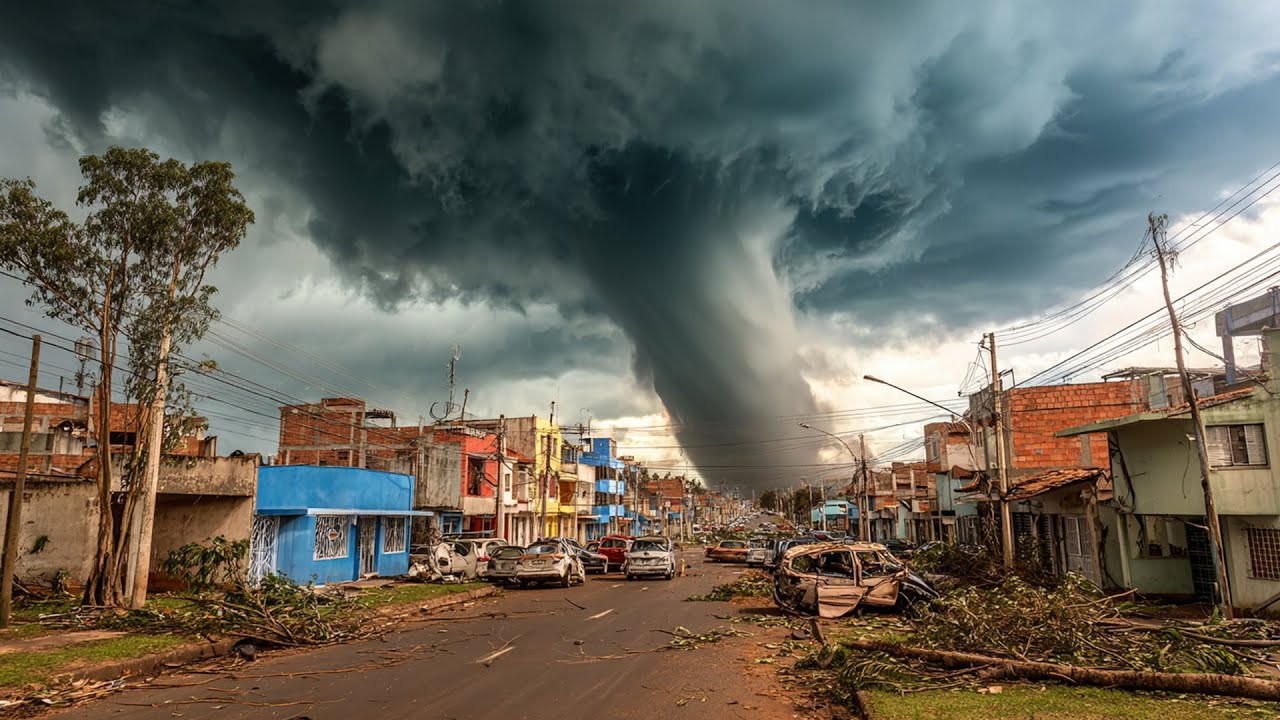
On November 7, several states in Brazil were hit by powerful storm winds accompanied by heavy rain and hail, caused by an extratropical cyclone. The states most affected by the disaster were Rio Grande do Sul, Santa Catarina, and Paraná.
In Porto Alegre, the capital of Rio Grande do Sul, wind gusts reached about 66 miles per hour. Around 800,000 people were left without electricity. In the municipality of Rolante, a young man died after being struck by a falling tree.
In Passo Fundo, hurricane-force winds knocked down trees, brought down power lines, and shattered windows on the upper floors of buildings. Due to the full mobilization of fire and rescue services to deal with the storm’s aftermath, the graduation ceremony of the “Junior Firefighter” program was canceled.
In addition to the strong winds, hail of medium and large size was reported in several areas. Heavy rainfall affected the central and northern regions of the state — in some places, more than six inches of rain fell in just 24 hours, exceeding the normal monthly average.
In the Serra Gaúcha region, numerous landslides caused transportation disruptions and property damage. In Caxias do Sul, a landslide hit a residential house and four vehicles, but fortunately, no one was injured.
The most tragic event occurred in the state of Paraná, where a powerful tornado destroyed up to 90% of the municipality of Rio Bonito do Iguaçu. Within just a few minutes, entire neighborhoods were reduced to rubble, and cars were tossed around like toys. The city looked like a war zone — no electricity, no water, no communication, while rescue teams worked for hours, searching through the debris.
The disaster claimed the lives of 6 people — 5 in Rio Bonito do Iguaçu and one in nearby Guarapuava. Another 750 were injured, thirty of them seriously. A field hospital was deployed to provide medical assistance, and at least one thousand residents were left homeless. Temporary shelters were set up in nearby towns.
Although the municipality was devastated, people did not lose hope: some helped their neighbors, others were simply grateful to be alive. Aid began arriving from neighboring cities, while volunteers and locals cleared the streets and collected debris.
One survivor said, “The wind took everything except the will to live.”
The scale of destruction forced authorities to declare a state of emergency in at least 14 cities of the state. Since Friday, 835 medical assistance requests have been recorded; 32 people remain hospitalized, 4 of them in intensive care.
A preliminary assessment by MetSul Meteorologia indicated that the tornado reached Category Four on the Enhanced Fujita Scale (EF-4), with wind gusts estimated between 155 and 186 miles per hour.
According to MetSul Meteorologia, the tornado in Rio Bonito do Iguaçu was one of the most powerful in the world this year and the most destructive in Brazil’s modern history.
Field analyses and radar data confirmed that within the same storm system, three additional tornadoes formed in the neighboring state of Santa Catarina, causing significant damage in the municipalities of Dionísio Cerqueira, Xanxerê, and Faxinal dos Guedes.
It is important to understand that the intensification of natural disasters began decades ago — what we are witnessing now is simply the visible phase of that process. Unusual weather phenomena, which have been occurring in various regions for several years, will continue to increase in both frequency and magnitude.
To gain a deeper understanding of what is happening to our planet, we recommend watching the video address by Dr. Egon Cholakian. In it, he thoroughly explains the causes of these events, analyzes their consequences, shares forecasts for the future, and presents scientific approaches to possible solutions to this global problem.
Publication of this material provides an opportunity for open discussion and does not in itself imply institutional endorsement, confirmation, or scientific verification of the views expressed. The material does not constitute an official statement, expert opinion, or professional advice.