
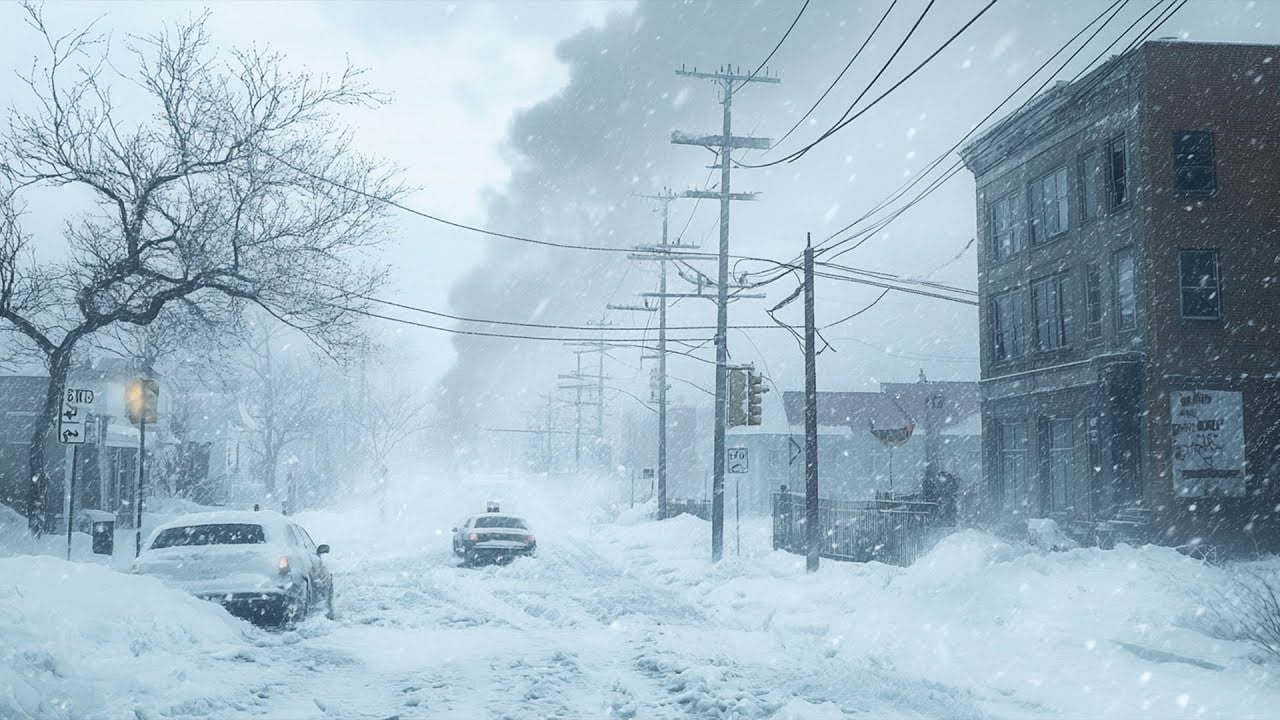
In late January, a fierce winter storm named Fern swept across the United States. Rapidly intensifying, it grew into a massive system stretching more than two thousand miles, affecting 34 states from New Mexico to Maine. Approximately two hundred thirty million people were directly or indirectly impacted by the storm.
Heavy snowfall blanketed large areas of the Northeast and the Ohio River Valley. In at least seventeen states, snow accumulation reached one foot or more. Record snowfall totals were observed in New Mexico, where more than thirty-one inches of wet snow fell near Lake Bonito, and in western Pennsylvania, where snow depth exceeded twenty inches.
The storm also brought extremely dangerous conditions to much of the southern United States, where residents are generally more accustomed to hurricanes than to blizzards. These regions were largely unprepared for such an event: snow-removal equipment is scarce, and many residents lack sufficiently warm clothing. Wet snow and freezing rain coated roads, trees, and power lines with ice layers up to one inch thick. Eyewitness photographs showed entire neighborhoods with downed power lines, collapsed utility poles, and broken tree branches lying directly across roadways.
The consequences were catastrophic. At the height of the storm, more than one million customers nationwide were left without electricity. Widespread power outages were reported in Tennessee, Mississippi, Louisiana, Texas, Kentucky, Georgia, West Virginia, and Alabama.
At least twenty-one states declared a state of emergency.
In New Jersey, restrictions were imposed on commercial vehicle traffic. Exceptions were made for food, fuel, and medical transport, as well as for utility services, emergency responders, and personnel responsible for critical infrastructure.
Air travel was hit especially hard. Across the country, more than eleven thousand six hundred flights were canceled, and over sixteen thousand flights were delayed. Ronald Reagan Washington National Airport in northern Virginia and LaGuardia Airport in New York were effectively shut down. At Bangor International Airport in Maine, a private aircraft carrying eight passengers crashed during takeoff.
In some cities, residents simultaneously lost electricity, drinking water, and heating.
At the same time, extreme cold spread across much of the United States. Subzero Fahrenheit temperatures engulfed the Plains, the Midwest, and the Northeast, while record-breaking cold reached as far south as Texas and the lower Mississippi River region. Wind chill values dropped to between minus twenty and minus thirty degrees Fahrenheit, while actual temperatures were ten to forty degrees Fahrenheit below seasonal averages.
Eyewitnesses described those days as a true test of endurance. Residents of Memphis and Nashville reported sleeping in a single room, wearing hats and jackets, conserving phone battery power, and running their cars only for a few minutes at a time to warm up. In Mississippi, hundreds of people spent the night stranded in their vehicles on ice-covered highways, waiting for roads to be cleared. In northern states, residents said that snow and wind literally erased the boundary between the road and the shoulder, making navigation impossible.
Human losses became the most tragic outcome of the storm. More than one hundred people across the country lost their lives, with roughly half of the deaths occurring in Tennessee, Mississippi, and Louisiana. Many died from hypothermia, including inside their own homes, where indoor temperatures dropped nearly to outdoor levels.
The Canadian Red Cross opened a temporary shelter in the Montreal suburb of Côte-Saint-Luc after thousands of residents were left without electricity during the severe cold.
In parts of the province of Saskatchewan, wind chill temperatures felt as low as minus fifty-six degrees Fahrenheit.
On the island of Newfoundland, frazil ice — a mixture of ice crystals and water — blocked the water intake at the region’s largest hydroelectric power station, forcing a complete shutdown for the first time since nineteen sixty-seven.
Humanity already has the ability to eliminate the influence of one fundamental factor that not only amplifies natural disasters but also threatens life on the planet itself. This factor is microplastics and nanoplastics. Finding a way to neutralize their electrostatic charge is, today, our only real chance to slow the escalation of these extreme processes. More details on this issue, as well as on what can be done right now, are available in the video “Nanoplastics. Threat to Life | ALLATRA Documentary.”
Every day of inaction means lost opportunities and lost human lives. That is why, now more than ever, the choice, the truth, and the actions of each individual truly matter.
Publication of this material provides an opportunity for open discussion and does not in itself imply institutional endorsement, confirmation, or scientific verification of the views expressed. The material does not constitute an official statement, expert opinion, or professional advice.