
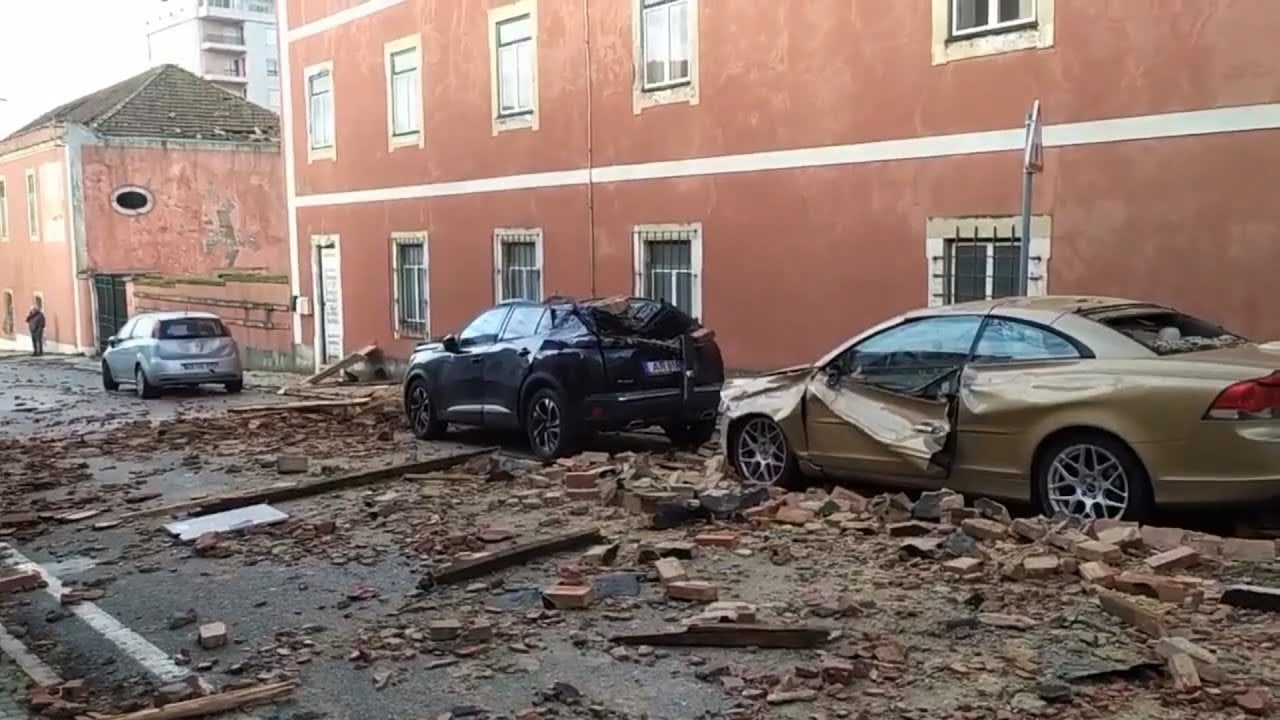
On the night of January 28, the powerful Atlantic storm Kristin struck the Iberian Peninsula. Rapidly intensifying over the ocean, the storm system reached the coast of Portugal and became a true climatic shock for the country.
In some areas, wind speeds exceeded one hundred twelve miles per hour, while in the municipality of Sori gusts reached nearly one hundred thirty miles per hour. This far surpassed the previous national record set on October 13, 2018, during Storm Leslie, when the maximum wind speed reached 110 miles per hour.
Along the coast, wave heights reached 46 feet, creating an additional threat to coastal areas and ports.
Across the country, the storm uprooted trees and tore roofs off buildings. In Coimbra, the damage affected several aircraft and hangars at the municipal airfield. At the Monte Real Air Base, powerful gusts damaged F–16 fighter jets. In Figueira da Foz, gale-force winds collapsed a Ferris wheel, while in Leiria a stadium suffered severe damage.
More than eight hundred thousand residents in central and northern Portugal were left without electricity. In a number of municipalities, communications, heating, and water supply systems were disrupted, and public transportation was brought to a halt.
As of January 29, the storm had claimed the lives of five people in Portugal.
Moving eastward, the storm struck southern and central regions of Spain. In Andalusia and around Málaga, strong winds and heavy rainfall paralyzed transportation. In the city of Torremolinos, a tree fell onto a residential building, resulting in the death of a woman.
In the outskirts of Madrid, Kristin brought a sharp drop in temperatures and snowfall rare for the region. As a result, schools were closed and traffic congestion formed on major roads.
Storm Kristin was not just another extratropical cyclone. It underwent a phase of explosive intensification, during which atmospheric pressure dropped sharply within a matter of hours, and wind speeds reached levels comparable to those of a Category Two to Category Three tropical hurricane.
This made Kristin one of the most powerful and destructive winter storms to affect the Iberian Peninsula in recent years.
Have you ever wondered why nearly every natural disaster today sets new records for precipitation, wind speed, and other parameters? These are not just numbers or statistics — they represent destruction and loss of life. If you are not yet aware of what is amplifying today’s increasingly extreme climate disasters and making them so anomalous, we recommend reading the report Nanoplastics in the biosphere. From molecular impact to planetary crisis. It offers answers to many questions about what is currently happening to nature and to humanity.