
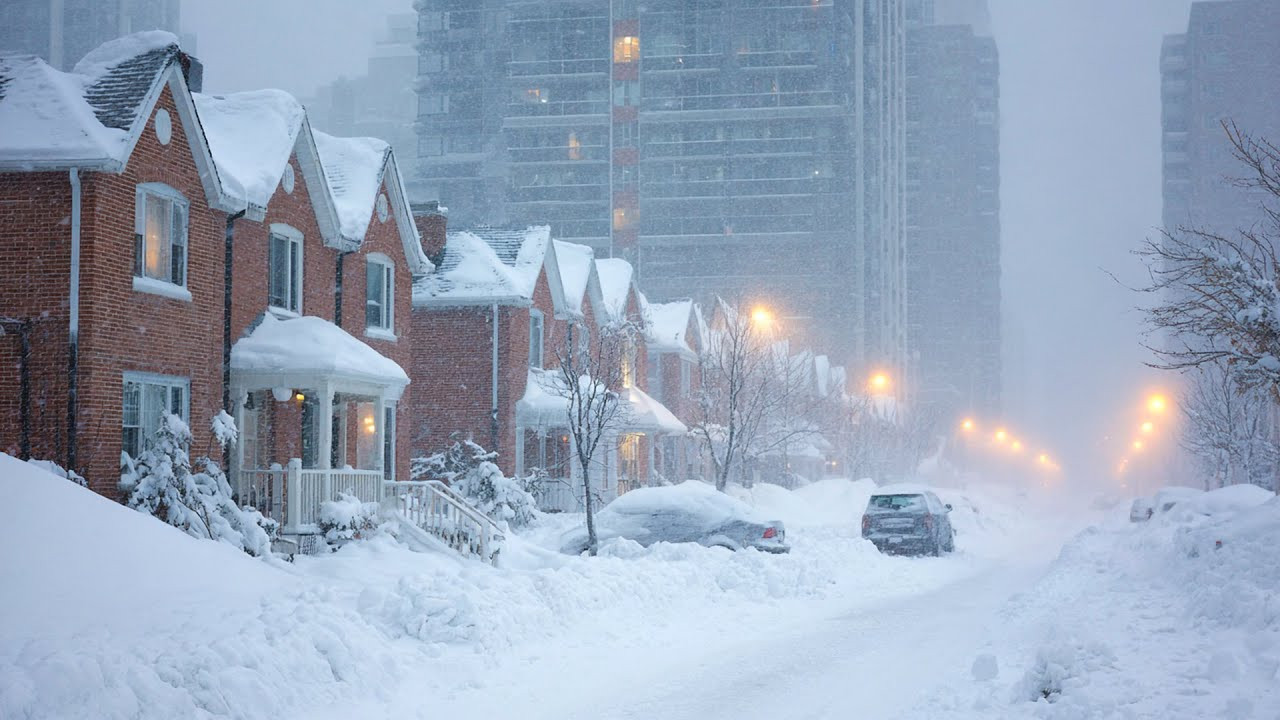
A rare and unusually early snowstorm struck southeastern Canada on November 9, 2025, covering the provinces of Quebec and Ontario.
In southern Ontario, in Toronto — the country’s largest city — nearly four inches of snow fell on November 9. It was the earliest snowfall of this magnitude in more than half a century, since 1969. Normally, snow of this volume does not arrive here until December. And in nearby Hamilton, up to 6.5 inches of snow accumulated — the earliest snowfall there since 1962. Ontario police recorded hundreds of traffic incidents within 24 hours.
In Quebec, some areas received up to 14 inches of snow overnight. The regions of Montérégie and Montreal were hit the hardest. Large numbers of fallen branches damaged power lines, leaving nearly four hundred thousand customers without electricity. Roads became covered with ice, causing serious accidents. Public works crews were clearing roughly 6,000 miles of streets and sidewalks.
The storm front also brought Arctic cold into the United States. Across the Midwest and the Great Lakes region, up to 12 inches of snow fell over 2 days. Highways around Chicago, Illinois, were buried, and traffic was paralyzed — prompting the first winter weather warning there in almost 2 years. Snow also fell in Michigan, Indiana, Ohio, Pennsylvania, and New York, where cold air from Canada clashed with a warm flow over the Great Lakes, intensifying the snowfall.
The cold wave then surged rapidly southward. By the morning of November 11, more than 190 million people across the United States were experiencing freezing temperatures. In Florida, Alabama, and Georgia, temperatures dropped 10 to 25 degrees Fahrenheit below normal, reaching 28 to 27 degrees Fahrenheit in some areas. Orlando saw only 37 degrees, while Jacksonville and Savannah dropped to 28 degrees, marking the coldest November morning since 1976. Even Miami cooled to 48 degrees, and residents witnessed iguanas falling from trees, stunned by the cold.
Meteorologists explain that the cause was a powerful polar vortex pulling Arctic air from northern Canada and even from near the North Pole — almost three weeks before the official start of winter.
Once again, we are witnessing anomalies and chaos in the natural processes of atmospheric circulation. Few people realize that one of the factors behind this planetary disruption — alongside rising temperatures — is micro- and nanoplastic pollution, with trillions of particles now filling Earth’s atmosphere. Learn more in the video: “Why Turbulence Is on the Rise? Egon Cholakian on Atmospheric Anomalies and Nanoplastic Pollution.”