
Since December 8, Brazil has been hit by a powerful extratropical cyclone. Due to its slow and unpredictable movement, hazardous weather conditions persisted for several days.
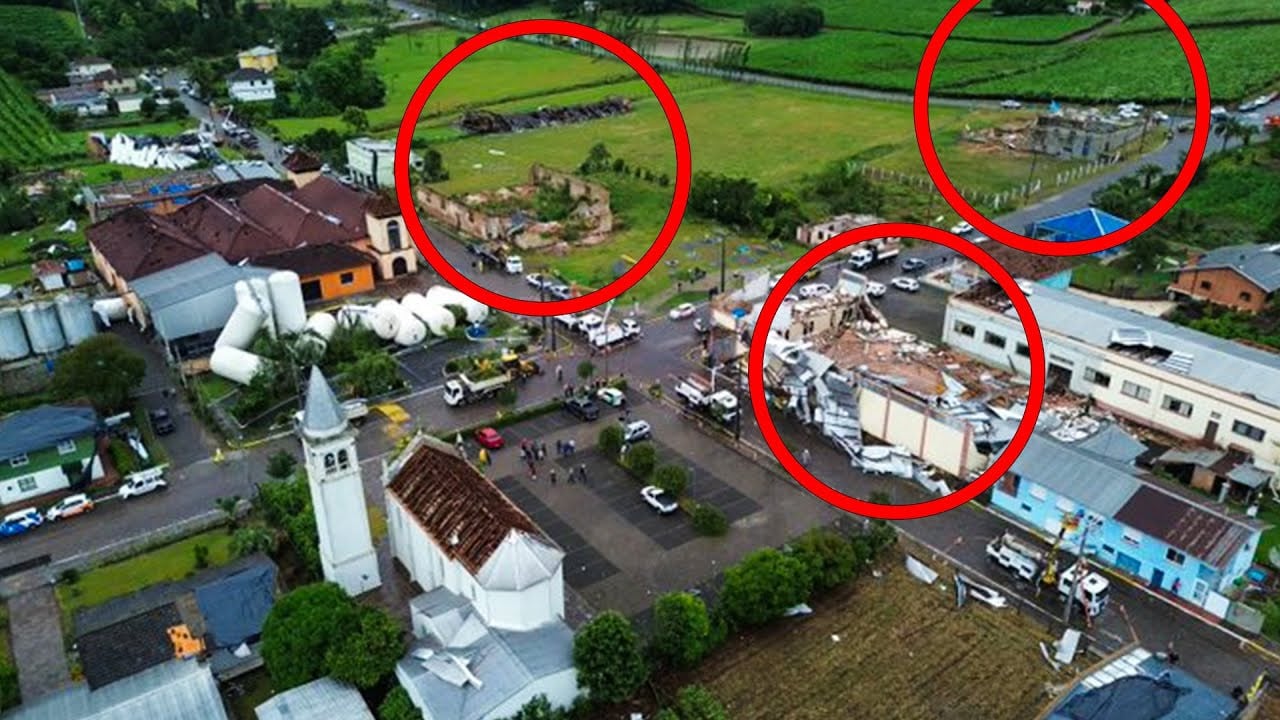
In the state of Rio Grande do Sul, a tornado was recorded, with meteorologists estimating its strength at the lower threshold of an F2 category. On the evening of December 8, it passed through the rural area of Travesan-Alfredo-Chavis in the municipality of Flores da Cunha.
Thousands of residents were left without electricity. Roofs of approximately sixty houses were partially or completely destroyed, and severe damage was reported to the local church, school, medical center, and several wineries.
The following day, the cyclone caused heavy rainfall. The coastal city of Osório experienced one of the most severe floods in its history: water levels rose unusually quickly, inundating areas that had never previously been affected by flooding. In several cities in the state, two to three times the monthly rainfall fell within thirty-six hours. For instance, in the municipality of Amaral Ferrador, 317 millimeters of rain fell during this period.
In the state of Santa Catarina, the city of Santa Amaro da Imperatriz, located in the Greater Florianópolis region, received 156 millimeters of rain in a single day. In the São Sebastião area of the municipality of Palhoça, a sudden flash flood swept away a car with a couple and their one-year-old child; unfortunately, all three perished. The downpours paralyzed traffic: major highways in the state experienced multi-mile traffic jams due to flooding.
On December 10, the cyclone moved toward the Atlantic coast, bringing squally winds to the southern and southeastern states. In five of these states, gusts exceeded 62 miles per hour. In the state of Paraná, in the Serra do Mar mountains, wind gusts reached 82 miles per hour, an extreme value for the region.
In the state capital, São Paulo, the wind toppled around five hundred trees and injured four people. More than six million residents of Greater São Paulo were left without electricity, causing water supply disruptions. Chaos at Congonhas and Guarulhos airports led to the cancellation of hundreds of flights. Meteorologists noted that such an event was rare for São Paulo: the city is accustomed to brief squalls during storms, but not to prolonged strong gusts lasting several hours.
As of December 13, a total of six people had died nationwide due to heavy rains, strong winds, and landslides.
Neither experts nor local residents expected such a powerful cyclone in December, during the Southern Hemisphere summer. Usually, such systems strengthen over the ocean and weaken over land; however, in this case, the cyclone reached its maximum intensity already over the continent. Pressure at its center dropped to 992 hectopascals, one of the lowest values in recent decades; this record low was observed in Porto Alegre.
Before the affected regions could recover, on December 12, a new wave of severe weather struck, bringing strong winds and torrential rains. The climax occurred on December 15, when a cold front encountered intensely heated air, generating squalls with speeds of up to 81 miles per hour. In the city of Bom Princípio, Rio Grande do Sul, the air temperature reached 97 degrees Fahrenheit.
The disaster affected more than 54 municipalities, leaving thousands of residents without electricity and water once again. In Porto Alegre, falling branches injured people, while in Cruz Alta, the wind tore off roofs and toppled trees. In the city of Guaíba, a twenty-four-meter-tall statue resembling the Statue of Liberty collapsed.
Cyclones and other atmospheric phenomena have increasingly been behaving in completely atypical ways. Scientists associate such abnormal manifestations with a fundamental disruption of energy exchange and circulation in the Earth’s atmosphere. One of the underlying causes of this pathological process is the presence of enormous quantities of microplastic and nanoplastic particles in the atmosphere. How this was discovered, what consequences it has, and whether science has a solution can be explored in the new investigative documentary “Nanoplastics. Threat to Life | ALLATRA Documentary.”