
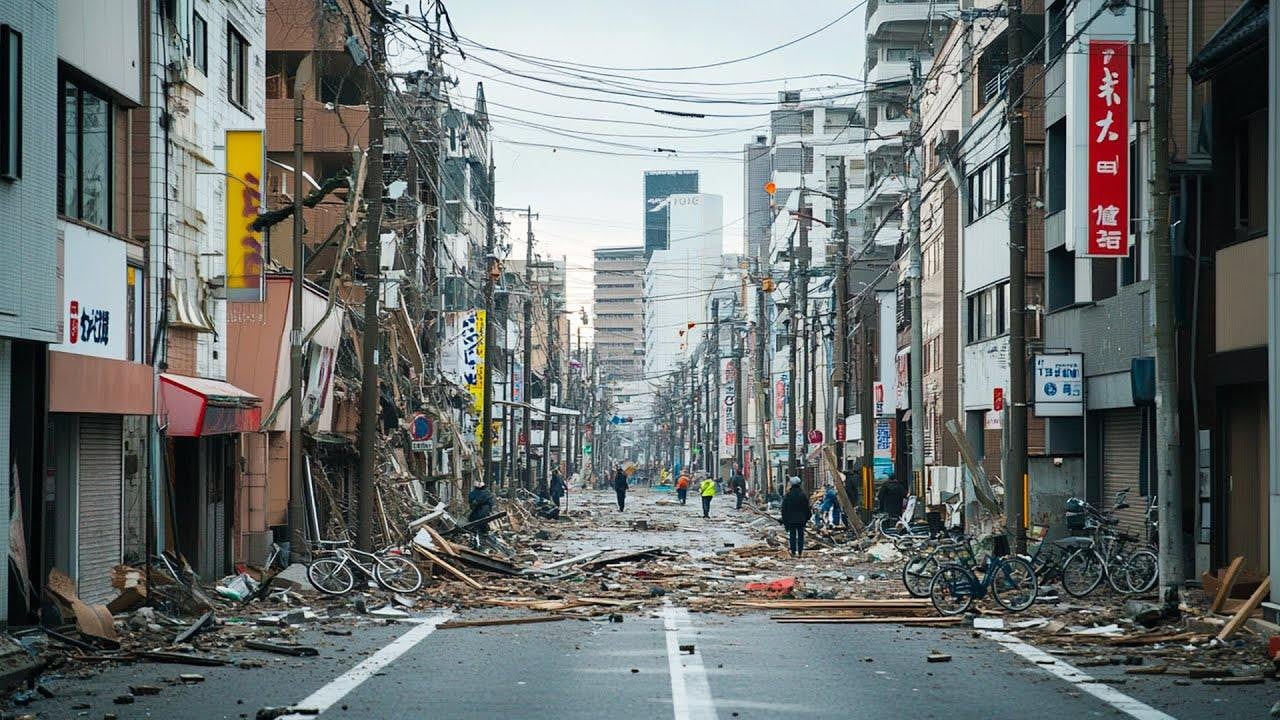
The end of 2025 and the beginning of 2026 were marked by increased seismic activity. Over just three weeks, there were 95 seismic events with magnitudes of 5 and above, nine of which were extremely strong, with magnitudes of 6 and above.
Here are just a few of them.
On January 6, 2026, at around 10:18 in the morning local time, an earthquake with a magnitude of 6.2 occurred in the eastern part of Shimane Prefecture, Japan, with a focal depth of approximately 6 miles. The maximum seismic intensity of 5+ was recorded in the cities of Matsue and Yasugi (Shimane Prefecture) and in Sakai Minato, as well as the towns of Hino and Kofu (Tottori Prefecture), with shaking felt over a wide area from northern Kyushu to the Kinki region.
User reports indicate falling objects and halted elevators, especially near the epicenter, while there was no threat of a tsunami.
An earthquake with an intensity of 5+ or higher, whose epicenter is located in the eastern part of Shimane Prefecture, has been recorded for the first time since 1919, that is, since systematic observations began by the Japan Meteorological Agency.
On January 9, at 4:36 in the afternoon local time, Peru experienced an earthquake with a magnitude of 5.3 in the Ica region, with the epicenter twenty-seven kilometers (approximately seventeen miles) south of Palpa. The focal depth was thirty miles. The tremors were mostly felt in the southern districts of Lima — Chorrillos, Villa El Salvador, and Villa María del Triunfo — as well as in the Nazca province.
Two weeks earlier, the country experienced a stronger earthquake. On December 27, 2025, at 9:51 in the evening Eastern Time, an earthquake with a magnitude of 6.2 occurred. The epicenter was twenty-two miles east of Puerto Santa, and the seismic focus was at a depth of forty-one miles. It resulted in 25 injuries, twelve of which required hospitalization, and caused material damage, including damage to the main hospital, schools, and residential buildings.
Later that same day, at 11:05 in the evening local time, a strong earthquake with a magnitude of 7.0 struck off the northeast coast of Taiwan. The epicenter was located in the sea approximately twenty-one miles east of Yilan County, near the city of Toucheng, with a focal depth of about forty-five miles. The shaking was felt across nearly the entire island for a duration of ten to twenty-one seconds. A national earthquake warning was issued fifteen point two seconds after the quake began; the delay was attributed to the great focal depth and the offshore location of the epicenter.
No reports of casualties or injuries were received. In some areas, there were gas and water leaks, cracks in pedestrian crossings, and localized structural damage; goods fell off shelves in stores. Taiwan Railways temporarily suspended service on the Jiaoxi — Suao-Xin section, six high-speed rail trains were delayed, and the Taipei Metro operated at reduced speed for about twenty minutes.
Unfortunately, what Allatra scientists have been warning about for many years is unfolding before our eyes. The global community has not yet responded with sufficient responsibility and action to the forecasts of the exponential increase in earthquakes worldwide. Apparently, this is because neither the scientific community nor the governments of countries currently have effective measures to counter such a planetary threat.
Therefore, it is crucial that everyone becomes aware that even at this stage, there are solutions that can be applied in the fight against the climate crisis. We encourage you to familiarize yourself with them and share this information with everyone around you.
Publication of this material provides an opportunity for open discussion and does not in itself imply institutional endorsement, confirmation, or scientific verification of the views expressed. The material does not constitute an official statement, expert opinion, or professional advice.