
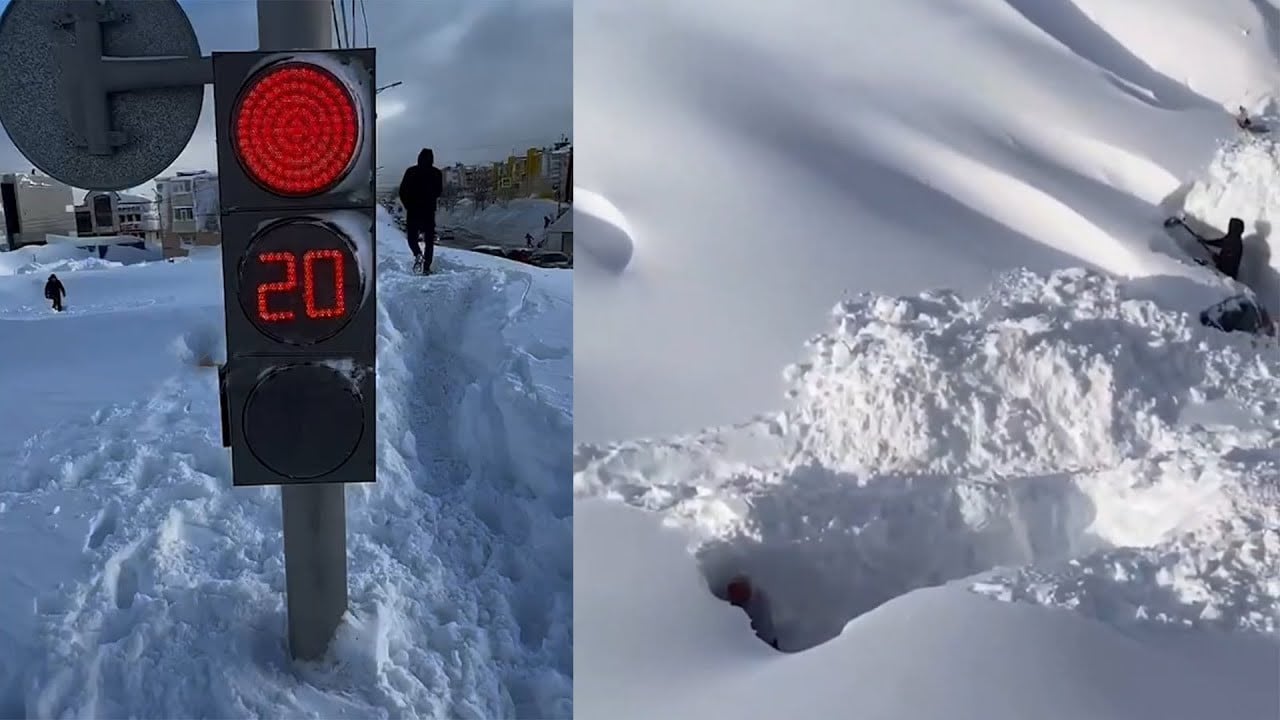
The winter of 2025 through 2026 became one of the harshest for Russia’s Kamchatka in recent decades and effectively turned into a prolonged snow blockade.
As early as December 2025, the situation began to move beyond normal conditions. In southern Kamchatka, three episodes of extremely heavy precipitation were recorded and classified as hazardous meteorological events. In Petropavlovsk-Kamchatsky, about 14.6 inches of precipitation fell in a single month — more than three monthly averages.
In January 2026, the snowfall not only failed to stop but intensified. During just the first half of the month, an additional 6.4 inches of precipitation fell in the regional capital. The snow cover depth at the Petropavlovsk-Kamchatsky weather station reached about 5 feet 7 inches, while in some districts of the city and surrounding suburbs, snowdrifts exceeded 8 feet. According to the Kamchatka Department of Hydrometeorology, such conditions had not been observed in the region for more than fifty years — the last comparable winter occurred in the early 1970s.
Beginning on January 13, the regional capital was hit with more than a full month’s worth of snowfall in just four days — about 5.1 inches of precipitation.
The storm was accompanied by extremely strong winds, with gusts in some areas exceeding 62 miles per hour, causing snow not merely to accumulate but to form dense snow “dunes” several stories high near buildings. Building entrances were blocked, and snow pressure forced in doors and first-floor windows. Residents escaped their homes through windows, jumping directly into the snowdrifts.
Many residents compared the situation to a blockade, noting that by the fifth day of the storm, snow removal had affected only the main highways.
Even satellite imagery showed the capital of Kamchatka Krai almost completely concealed beneath a dense layer of snow.
Roads were closed, schools were shut down, public transportation was suspended, and the city’s infrastructure entered a state of collapse. Stores were rapidly emptied, with only cereals and instant noodles remaining on shelves.
Local residents reported that weather forecasts had in no way prepared them for what occurred. Expecting to wait out the storm for just a few hours or, at most, miss a day of work, many found themselves trapped in their homes for five days without sufficient food supplies.
The disaster resulted in loss of life. On January 15, in the Seroglazka district, a sixty-two-year-old man was killed when a mass of snow collapsed from the roof of a private house. The following day, January 16, another elderly man in Petropavlovsk-Kamchatsky was struck by a falling snow mass from the roof of a residential building. Witnesses managed to dig him out while he was still alive, but due to completely uncleared streets, an ambulance arrived only several hours later — the victim died from injuries. Following these tragedies, city authorities declared a state of emergency, announced avalanche danger, and urged residents to remain indoors and avoid walking beneath sloped roofs.
At Kamchatka’s main airport, dozens of flights were canceled, including routes to remote settlements in the northern part of the peninsula. Power outages were recorded in some areas, posing a particular danger to the private housing sector, where most homes rely on electric heating — buildings cooled down within just a few hours.
Emergency services were physically unable to respond to all calls, and people began to unite to dig out homes on their own, help elderly neighbors, and transport them to doctors. According to residents, only after the city is fully cleared will it become clear how many elderly people living alone did not survive that snowbound week.
Experts explained the extreme precipitation in Kamchatka by an anomalous configuration of atmospheric circulation. Over the northern Pacific Ocean and the Sea of Okhotsk, a multi-center low-pressure system formed — the Aleutian Low, displaced farther west than usual. This configuration created a persistent mechanism for pumping moist oceanic air toward Kamchatka, where it collided with icy air intrusions from Yakutia. Each new influx of warm, moisture-laden air led to intense precipitation: rain fell over the sea, while heavy, wet snow accumulated along the coast and deep within the peninsula.
But what caused this anomaly to form in the first place?
Scientists from ALLATRA have already provided a preliminary answer to this question in the scientific report “Nanoplastics in the Biosphere: From Molecular Impact to Planetary Crisis.”
Their findings shed light on many previously unexplained climatic processes.