
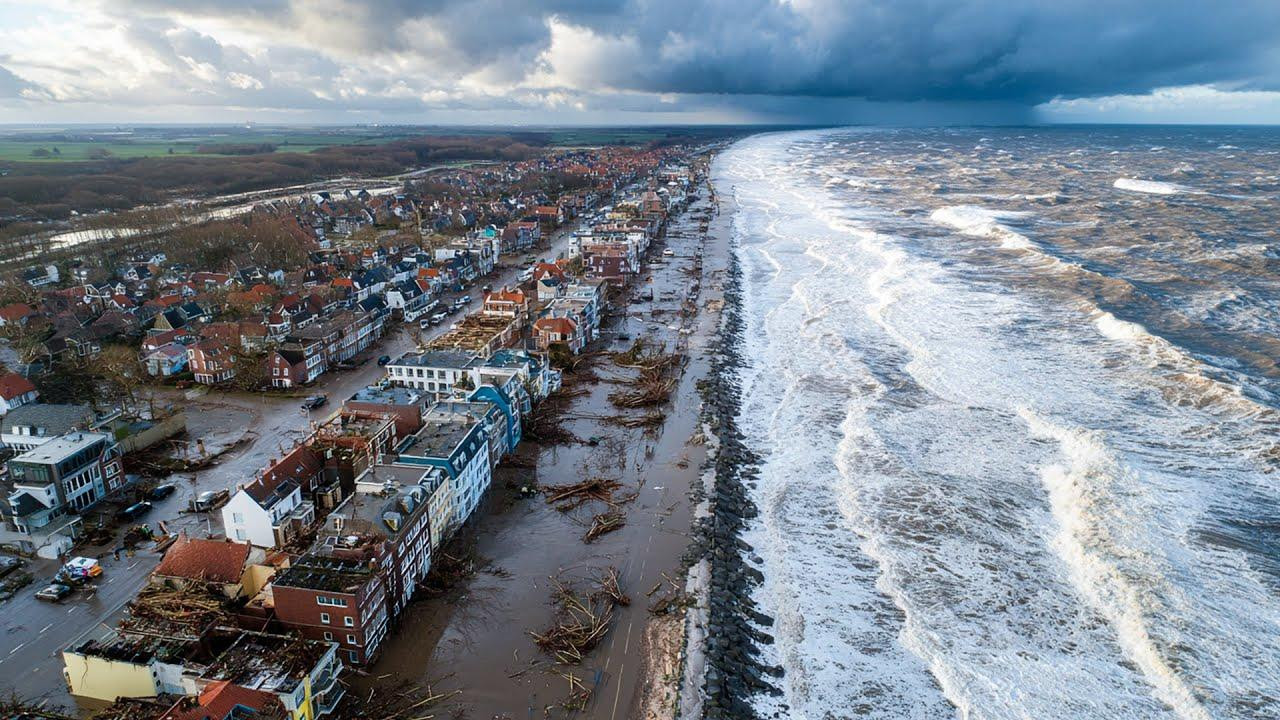
Starting on October 23, storm Benjamin swept across Europe, bringing hurricane-force winds, torrential rains, and severe flooding. An orange level of danger was declared in seven countries — Switzerland, Belgium, France, the United Kingdom, the Netherlands, Spain, and Portugal.
The storm paralyzed transportation across the continent — roads, railways, ferries, and air travel were all affected. Within 24 hours, major airlines canceled more than 260 flights, and over 870 were delayed. Thousands of passengers were stranded in airports across London, Amsterdam, Paris, Dublin, and Frankfurt.
France suffered the most severe impact. Along the English Channel and Atlantic coasts, hurricane-force winds battered the region. On the island of Corsica, in the commune of Cagnano, Météo France reported wind speeds reaching 104 miles per hour.
Falling trees injured seven people in various regions.
In the Bay of Biscay, waves exceeded 46 feet in height. More than 140,000 households were left without power. In Paris and its suburbs, parks and gardens were temporarily closed for safety reasons.
In Cherbourg, the city center was flooded, with water levels reaching about 28 inches in some areas.
Heavy rainfall hit the departments of Corrèze and Cantal especially hard: in Corrèze, 4.7 inches of rain fell over two days, while in Cantal, 4.3 inches fell in just 24 hours.
On Corsica, tragedy struck when a man was swept away by a powerful surge of the Fango River while swimming with his family. His wife and two children were rescued.
In Switzerland, a ferry company suspended all services on Lake Geneva. Near the city of St. Gallen, a strong gust of wind overturned a trailer, blocking the A13 highway for two hours.
In the United Kingdom, more than two thousand homes in Suffolk County were left without electricity. In Hertfordshire, gusts of wind up to seventy-five miles per hour knocked down trees, blocking railway lines and halting train services.
In the Netherlands, squalls and heavy rain caused massive traffic jams — during rush hour, the total length of congestion exceeded 560 miles. High-speed train services were also suspended.
In Spain, firefighters responded to more than six hundred emergency calls as the wind uprooted trees and damaged buildings. In Barcelona and nearby suburbs, more than three thousand five hundred people were left without power.
A total of 26 people were injured, 11 of them hospitalized. On the Catalan coast, in the province of Tarragona, a man was swept away by powerful waves and drowned.
Storm Benjamin has become yet another reminder that natural disasters have reached a new level — one for which many people are unprepared, both physically and mentally. Whether or not we choose to acknowledge the escalation of climate anomalies, the statistics speak for themselves.
In his video address, “Why Turbulence Is on the Rise? Egon Cholakian on Atmospheric Anomalies and Nanoplastic Pollution,” Dr. Egon Cholakian, a representative of the ALLATRA International Scientific Group, outlined the causes of various atmospheric anomalies and explained what must be done now to halt the progression of the climate crisis.
Publication of this material provides an opportunity for open discussion and does not in itself imply institutional endorsement, confirmation, or scientific verification of the views expressed. The material does not constitute an official statement, expert opinion, or professional advice.