
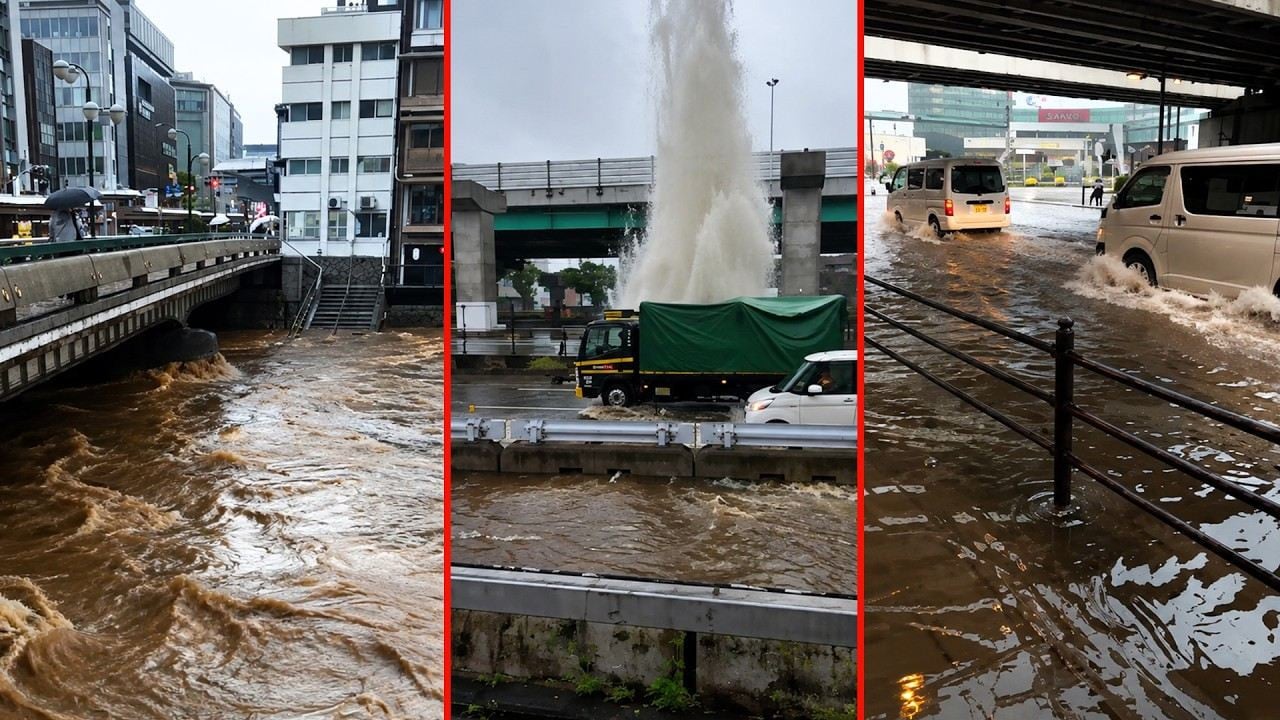
In late June, Japan and Taiwan faced a prolonged series of powerful downpours during East Asia’s rainy season. In Taiwan, rainfall intensified as Typhoon Mekkhala approached, while in Japan, the seasonal rain front was affected by two tropical cyclones at once: Mekkhala and Higos.
Mekkhala rapidly gained strength over the Philippine Sea. By June 22 and 23, its maximum sustained winds had reached approximately 115 miles per hour. At around the same time, Higos formed near the Mariana Islands. The tropical cyclones followed different tracks: Mekkhala passed closer to the island of Taiwan and Japan’s Ryukyu archipelago, while Higos remained farther east and headed toward Japan.
Mekkhala did not make landfall in Taiwan, but its outer circulation strengthened the moisture-laden southwesterly flow. As a result, extreme downpours began in the southern part of the island. By June 25, more than 15 and three-quarter inches of rain had fallen in Jiuru Township, Pingtung County. Over the following several days, rainfall in some rural areas approached 40 inches.
Kaohsiung, Pingtung, and Tainan were the hardest-hit areas. Schools and government offices were closed in several districts, while flooding disrupted service on the main rail line connecting the northern and southern parts of the island. In Hualien, nearly 200 people were evacuated from communities located downstream from a rapidly filling landslide-dammed lake. By June 27, three people had been reported dead and one person was missing.
In Japan, the situation developed according to a more complex scenario. Warm, humid air from the two typhoons fed the seasonal Baiu front, causing heavy rainfall even before the cyclones made their closest approach. The downpours initially affected western Japan. On June 26, the Kamo River was reported to have overflowed in Kyoto, while dozens of homes were flooded in Nara and Hiroshima prefectures. The area of the most intense rainfall then shifted eastward toward the Kanto and Tokai regions, as well as the Boso Peninsula.
Evacuation orders in Japan affected approximately one million people. More than 200 flights were canceled, train services were suspended, expressways were closed, and Toyota temporarily halted operations at a plant on Kyushu. At several weather stations in Chiba Prefecture, new June rainfall records were set for 24-hour, 48-hour, and 72-hour periods.
This episode illustrates one of the defining features of modern climate change: hazardous events are increasingly occurring at the same time and intensifying one another. A familiar rainy season can become significantly more destructive when it coincides with an influx of moisture from one or more tropical cyclones. Meteorologists, government authorities, emergency services, and residents themselves must therefore be prepared for such combinations. People need to understand how quickly an ordinary weather situation can develop into a serious threat.
Publication of this material provides an opportunity for open discussion and does not in itself imply institutional endorsement, confirmation, or scientific verification of the views expressed. The material does not constitute an official statement, expert opinion, or professional advice.