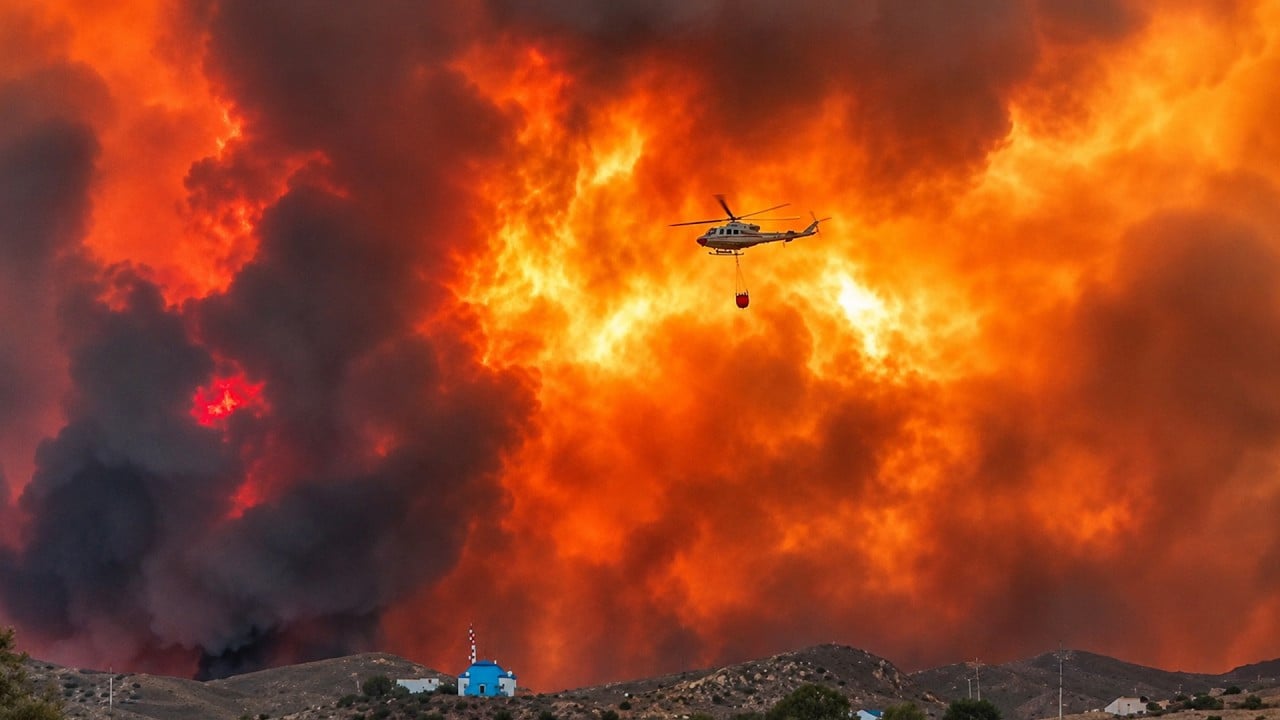
Hot, dry weather led to a sharp deterioration in wildfire conditions across southern Spain.
On July 9, a wildfire broke out near the N-340 highway in the municipality of Los Gallardos, Almería Province. It subsequently became the deadliest wildfire in the history of Andalusia.
Several factors contributed to the fire’s rapid spread. After abundant winter rainfall, vegetation grew extensively across the region. However, the extreme heat of May and June quickly dried it out. As a result, grasses and shrubs were transformed into highly flammable fuel.
Strong winds drove the flames forward at a rate of up to approximately 328 feet per minute. In just two hours, the fire front traveled about nine miles and reached the neighboring municipality of Bédar. Dense smoke forced regional road authorities to close two major highways in the affected area.
The authorities carried out a large-scale evacuation. More than one thousand five hundred people were forced to leave their homes. However, because of the scattered pattern of development and the characteristics of the terrain, the same instruction was not suitable for everyone. In some areas, it was safer to leave immediately, while in others, remaining inside buildings was the safer option.
Some residents of Bédar were evacuated in advance. Later, when the roads became too dangerous, those who remained were advised not to leave their homes. Despite the warning, several people attempted to escape the town on their own through a dry riverbed, which became a deadly trap as the fire spread rapidly.
As of July 12, twelve people had died in the fire. Four were found inside a vehicle. Another eight people are believed to have abandoned their vehicles and attempted to continue on foot. Eight people were also injured, four of whom were in serious condition.
Firefighting operations were complicated by the mountainous terrain, steep slopes, and numerous ravines that heavy equipment could not access. More than four hundred sixty personnel were mobilized to fight the fire, along with 32 aircraft, including airplanes and helicopters.
The fire was not contained until after three days of continuous efforts. A change in the weather helped improve the situation: temperatures fell, winds weakened, and relative humidity rose to 50 percent.
By July 12, the fire had burned through approximately seventeen thousand three hundred acres.
Experts note that wildfires of this scale previously tended to occur in the region only in August. The dangerous season now begins much earlier. High temperatures and prolonged dry periods cause vegetation to lose moisture more quickly, making it increasingly vulnerable to ignition.
As of July 12, the total area burned in Spain since the beginning of the year had exceeded approximately one hundred fifty thousand seven hundred acres, which was about 52 percent above the average recorded for the same period over the previous decade.
This fire once again demonstrated how important it is to understand the basic rules of behavior in advance when flames are spreading rapidly. However, even when emergency services are available, individuals cannot place the entire responsibility for their own lives on those services. Conditions during a wildfire can change within minutes. Communications may fail, roads may become blocked, and official guidance may arrive too late or may no longer reflect the situation in a particular location.
The key, therefore, is not simply to wait for instructions, but to understand possible evacuation routes in advance and have several potential courses of action. Guidance from emergency professionals should remain the primary point of reference, but during a critical situation, everyone must carefully assess what is happening around them. Personal responsibility does not mean ignoring warnings. It means being prepared, avoiding impulsive decisions, and understanding that, in some circumstances, the final decision may have to be made independently.
Publication of this material provides an opportunity for open discussion and does not in itself imply institutional endorsement, confirmation, or scientific verification of the views expressed. The material does not constitute an official statement, expert opinion, or professional advice.