
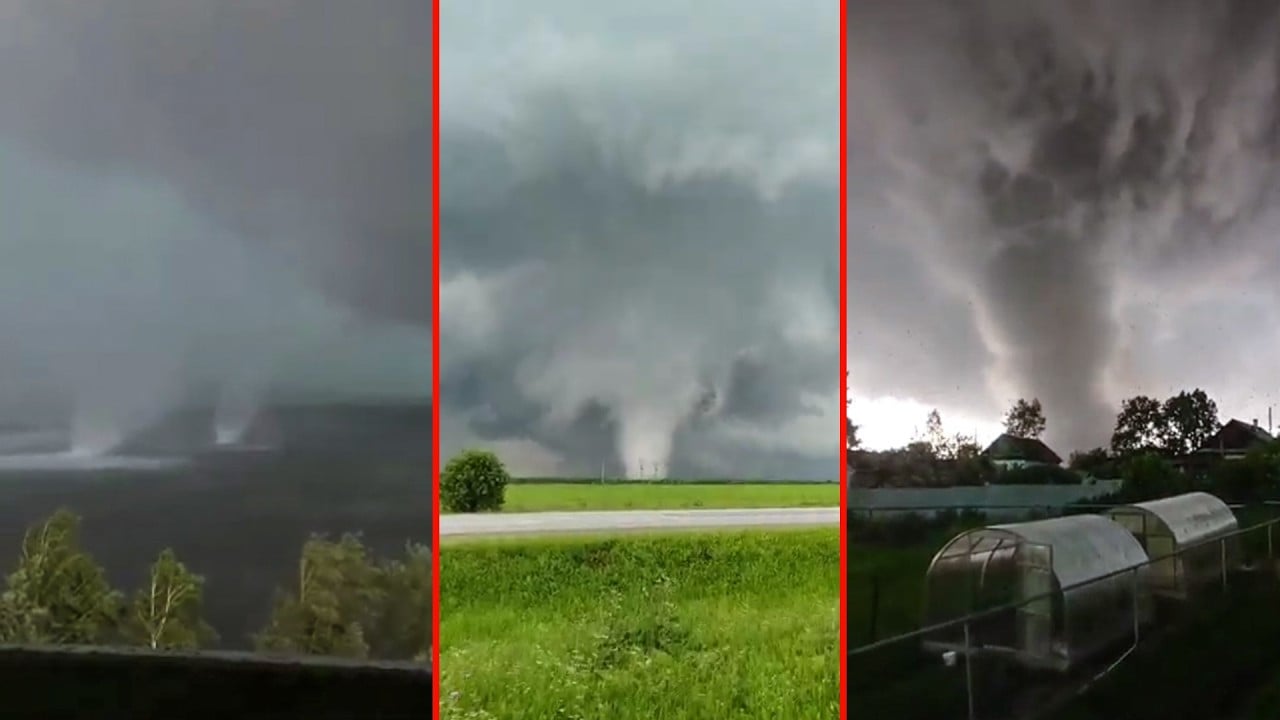
In Russia’s Sverdlovsk Region, the city of Kushva was struck by a tornado that is rare for the Ural region. On June 22, a powerful vortex moved not through a forested area, as more often happens in the region, but directly through the city’s built-up areas. That is why the consequences were extremely severe.
The damage path stretched for about one and a half miles. According to specialists, based on the nature of the damage, the tornado was classified as EF3 on the International Fujita Scale. For the Ural region, this was one of the strongest events of its kind in recent decades.
Eyewitnesses recalled that just before the impact of the storm, a loud roar could be heard. Along with the vortex, hail the size of quail eggs struck the city. The wind tore roofs off houses and lifted sheets of metal, pieces of building structures, branches, glass, and debris into the air.
The destruction in the private residential sector was especially severe. According to the Ministry of Emergency Situations, 32 private houses were completely destroyed, and another 99 sustained varying degrees of damage. On some streets, virtually only the walls of houses remained. Fences, greenhouses, and outbuildings were destroyed, vehicles were damaged, and many trees were uprooted.
Multi-story buildings were also hit: the tornado tore off their roofs and damaged balconies and facades. In just a few minutes, the city suffered extensive damage to its housing stock, power lines, and municipal infrastructure.
After the tornado passed, more than four thousand private homes in Kushva itself and in neighboring communities were left without electricity. Water supply disruptions occurred, and in some areas, gas service had to be temporarily shut off because of damage to gas pipelines.
21 people sought medical assistance after the storm. Most of them suffered cuts, bruises, and injuries from shards of glass and flying debris. Several people were hospitalized.
The power outage also led to an emergency situation at the Southern Mine. Because the lifting equipment stopped working, sixteen miners were trapped underground. They were brought to the surface only at around 4 o’clock in the morning the next day, after the power supply had been restored.
But the ordeal for the residents of Kushva did not end there. The very next day after the tornado, heavy downpours hit the city. Water began flooding living spaces in homes that had been left without roofs after the vortex, worsening the damage from the disaster that had already occurred.
This example clearly shows that amid the planet’s changing climatic and geodynamic situation, it is important to understand the nature of different hazardous phenomena, even those that previously seemed completely unusual for a particular region. The residents of Kushva could hardly have expected to face a tornado of such strength, yet reality shows that such events are already occurring in places where neither the infrastructure nor the people themselves were prepared for them. And the less society knows about how to recognize such a threat and how to act correctly, the higher the risk of severe consequences.
Publication of this material provides an opportunity for open discussion and does not in itself imply institutional endorsement, confirmation, or scientific verification of the views expressed. The material does not constitute an official statement, expert opinion, or professional advice.