
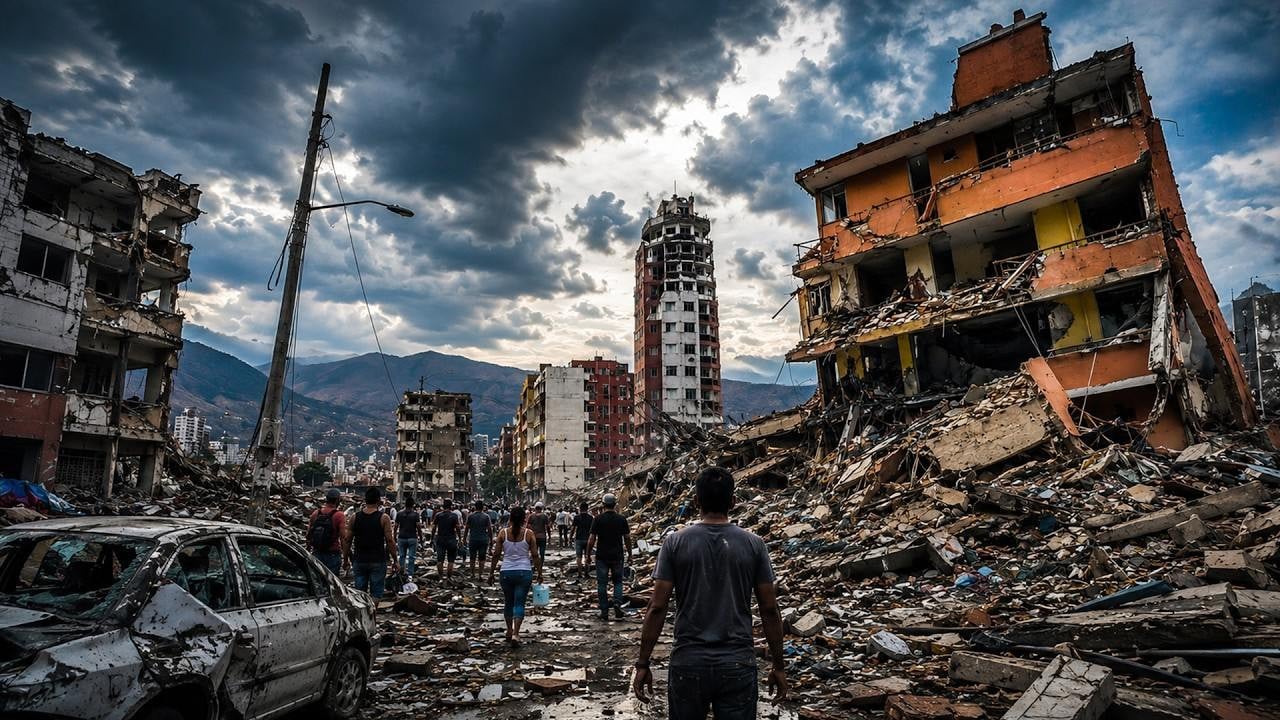
On June 24, Venezuela experienced one of the most destructive seismic episodes in the country in the past two centuries. It was a seismic doublet: two powerful earthquakes that occurred almost back to back, less than one minute apart. The first, with a magnitude of 7.2, was recorded at 6:04 p.m. local time, 15.5 miles east of San Felipe, at a depth of 13.6 miles. The second, stronger earthquake, with a magnitude of 7.5, occurred around 6:05 p.m., 17.4 miles northwest of San Felipe, but at a shallower depth of about 6.2 miles.
The seismic impact struck the densely populated north of the country, a region where the capital, Caracas, major transportation hubs, the international airport, residential areas, and port infrastructure are located. The situation was made more difficult by the fact that the earthquakes occurred on a holiday. As a result, not only local residents but also visitors were caught in the destruction zone.
The state of La Guaira was the hardest hit. It was this region that local authorities declared a disaster zone.
Local media reports described a grave scene: people gathered near collapsed buildings, unable to reach their relatives by phone and not knowing whether their loved ones were still alive. Residents reported that people remained trapped under the rubble and that they did not have enough strength on their own to move the concrete slabs.
They heard the voices of those people, and in the first hours they effectively cleared the rubble themselves, using their hands, ropes, and improvised tools, because specialized teams could not arrive at all destroyed sites at the same time.
Caracas was also among the seriously affected areas. In the capital, the destruction was more localized, but extremely severe in certain places.
Rescuers lacked specialized tools for cutting concrete and metal, as well as helmets, water, food, and basic equipment.
According to official data as of June 27, the death toll had reached 1,430 people. More than 3,200 people were injured.
The medical system operated around the clock. In the capital region, in addition to the public health network, private clinics were also involved in receiving the injured, conducting examinations, and hospitalizing patients.
Large public facilities began to be used as temporary shelters. In La Guaira, one of the major stadiums was set up to provide accommodation and medical assistance. For those who were afraid to return home because of aftershocks and cracks, open spaces were used, including squares, parks, and temporary camps.
Aid for the victims was collected across the country. Collection centers opened in different regions for water, nonperishable food, clothing, mattresses, blankets, hygiene products, and medicines. At the same time, the authorities restricted independent entry into La Guaira, explaining that it was necessary to keep the roads clear for ambulances, rescue vehicles, the military, police, firefighters, and civil protection services.
After the main shocks, intense aftershock activity continued. According to the authorities, by midday on June 27, 430 aftershocks had been recorded.
The earthquakes destroyed or seriously damaged at least 383 buildings, and a total of 1,423 infrastructure facilities across the country were affected, including 13 hospitals and 25 shopping centers.
Simon Bolivar International Airport in Maiquetia also sustained serious damage. Airport operations were restricted; some flights were canceled or diverted, and one of the runways remained closed. For the country, this had not only transportation significance but also humanitarian importance, because Maiquetia Airport is a key hub for Caracas and La Guaira.
As climatic and geophysical conditions on the planet continue to change, awareness of local risks is becoming extremely important for everyday safety.
Standard recommendations from emergency services include a number of preventive measures:
- Stay informed about possible hazards in your region.
- Know the action plans for natural disasters.
- Keep a basic emergency kit at home with essential supplies for several days.
More detailed information can be obtained from local emergency response services.
Stay safe and take care of your loved ones. Human life is the highest value.
Publication of this material provides an opportunity for open discussion and does not in itself imply institutional endorsement, confirmation, or scientific verification of the views expressed. The material does not constitute an official statement, expert opinion, or professional advice.