
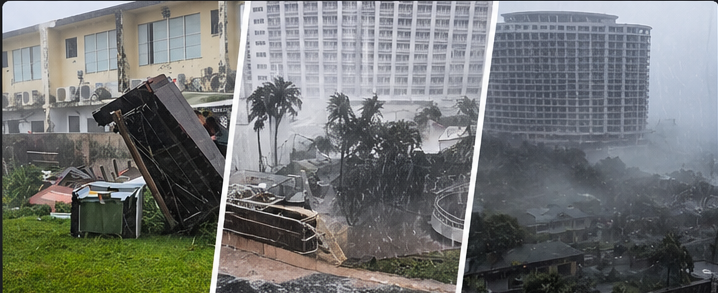
In early July, Tropical Storm Bavi formed over the western Pacific Ocean and began rapidly gaining strength as it approached the Mariana Islands.
The system developed at an exceptional rate. In just 36 hours, its sustained winds increased by more than one hundred miles per hour. By July 4, Bavi had reached super typhoon strength after undergoing a period of extremely rapid intensification.
The storm reached peak intensity on the morning of July 6. Sustained winds climbed to approximately 180 miles per hour, while individual gusts reached about 215 miles per hour. On the Saffir-Simpson Hurricane Wind Scale, this intensity was equivalent to a Category 5 hurricane, the highest classification.
The storm struck Rota with its greatest force. Rota is a small island with a population of approximately two thousand people and is part of the Northern Mariana Islands. The eye of the super typhoon passed directly over the island, placing Rota within the zone of the most destructive winds.
The damage affected nearly the entire island. Almost every home sustained damage, and even substantial concrete buildings were not spared. Some structures were completely destroyed, while others lost roofs, walls, and windows. Government buildings and public facilities were also severely damaged.
Both the airport and the seaport, the island’s main transportation links to the outside world, were damaged at the same time. Transportation to and from Rota was almost completely paralyzed. Electricity and water supplies were entirely cut off, leaving residents without power or reliable access to drinking water in the tropical heat.
Despite the enormous strength of the super typhoon and the widespread destruction, no deaths were reported on the island. Two people were injured.
However, Bavi’s impact was not limited to Rota. Hurricane-force conditions were also recorded on other islands across the archipelago.
On Guam, which is home to major United States military facilities, strong winds were accompanied by prolonged torrential rainfall.
Approximately twelve and three-tenths inches of rain fell within 24 hours, setting a new daily rainfall record for the island.
The intense rainfall triggered flash floods and landslides. Many roads became impassable because of flooding, fallen trees, and debris from damaged structures.
North of Rota, on Saipan and Tinian, the typhoon also brought down power lines, damaged residential and commercial buildings, and disrupted port operations.
For these islands, the new disaster was especially severe because they had not yet recovered from the previous storm. In mid-April, the region had been struck by Category 4 Super Typhoon Sinlaku.
During that storm, more than nineteen and seven-tenths inches of rain fell across the islands, causing widespread flooding, while power outages continued for several weeks. The damage was estimated at approximately one and a half billion United States dollars.
As a result, Saipan and Tinian experienced their second destructive typhoon in only three months. Bavi arrived while some buildings and infrastructure were still undergoing repairs. The new damage compounded the destruction caused by the April storm and made conditions even more difficult for local residents.
After passing through the Mariana Islands, Bavi continued across the Philippine Sea. The system gradually weakened but retained considerable strength and a broad area of storm-force winds.
On July 11, the typhoon reached the eastern coast of China and made landfall near the city of Taizhou in Zhejiang Province. By that time, sustained winds had decreased to approximately 89 miles per hour, equivalent to a Category 1 hurricane.
Although Bavi had weakened considerably compared with its impact on Rota, it still posed a serious threat to coastal communities. In anticipation of strong winds, torrential rain, and possible flooding, Chinese authorities carried out mass evacuations, while emergency services prepared for damage to buildings, roads, utilities, and other critical infrastructure.
This example shows that increasingly frequent climate-related disasters do not give communities enough time to recover fully. A new storm strikes homes, infrastructure, and local economies that have already been damaged, compounding earlier losses. When the consequences of several disasters overlap, the overall scale of destruction becomes significantly greater.
Publication of this material provides an opportunity for open discussion and does not in itself imply institutional endorsement, confirmation, or scientific verification of the views expressed. The material does not constitute an official statement, expert opinion, or professional advice.