What happens to plastic waste when it becomes invisible?
That’s exactly when the most understudied chapter of plastic pollution begins. Once plastic breaks down into micro- and nanoparticles, it stops being just trash. It takes on new physicochemical properties that significantly increase its ability to interact with the environment and living systems. For this very reason, nanoplastics have recently become a major focus of intensive scientific research worldwide.
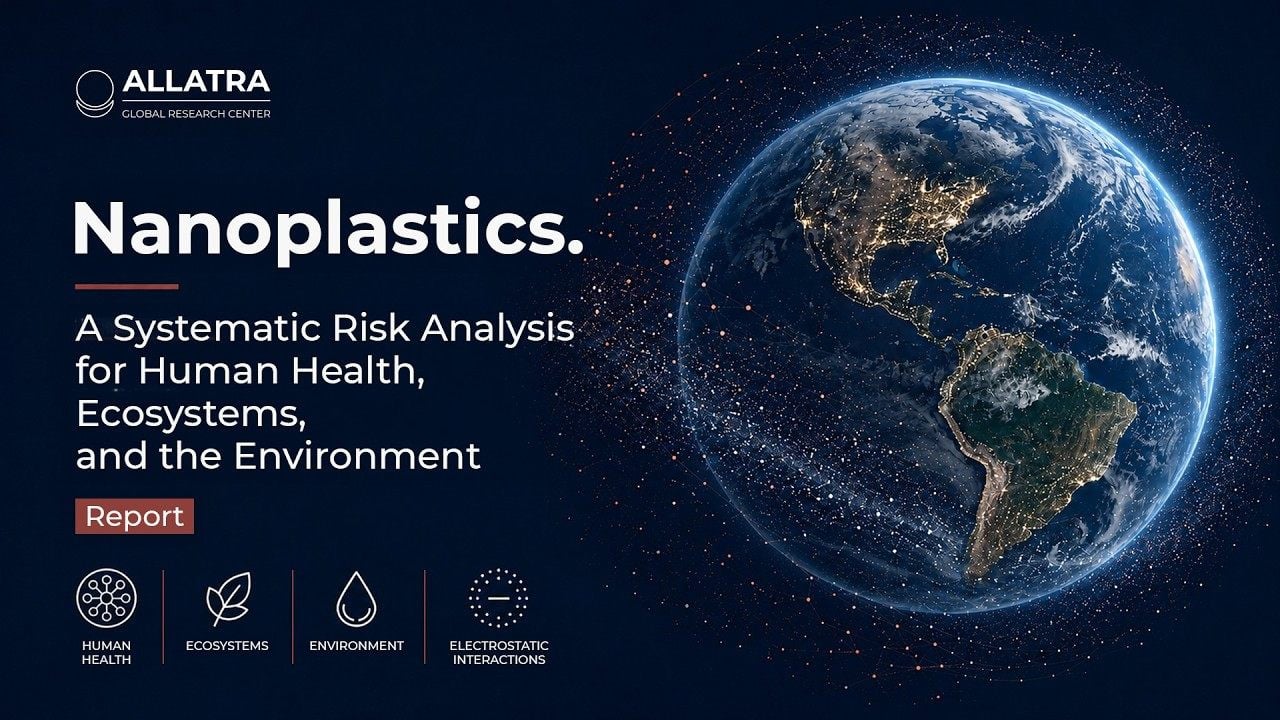
This video provides an overview of the landmark scientific report, “Nanoplastics: A Systematic Risk Analysis for Human Health, Ecosystems, and the Environment,” prepared by scientists at the ALLATRA Global Research Center.
The report synthesizes findings from 597 scientific publications, approaching micro- and nanoplastics not as isolated pollutants, but as part of a complex system of interactions, from the physical properties of nanoparticles to their impact on cells, tissues, organisms, and ecosystems.
Key topics include:
• Why nanoplastics cannot be treated simply as a scaled-down version of plastic waste;
• How particle size affects their physicochemical properties;
• How nanoplastics interact with proteins, cell membranes, and biological barriers;
• What we currently know about their presence in the environment and the human body;
• Why investigation of the electrical properties of nanoplastics can become one of the core trends for future research;
• What scientific challenges we must overcome to accurately assess risks and find effective solutions.
The report also outlines promising areas of future research, from exploring the surface and internal electrical structure of nanoplastics to developing international monitoring standards and fostering cross-disciplinary collaboration.
Report “Nanoplastics: A Systematic Risk Analysis for Human Health, Ecosystems, and the Environment” https://doi.org/10.65849/agrc.report.mnp.2026.04001
The report is available for free public access under the CC BY 4.0 license, allowing it to be used for scientific, educational, and public awareness purposes with proper attribution.
Learn more about the ALLATRA Global Research Center: allatra.org
Publication of this material provides an opportunity for open discussion and does not in itself imply institutional endorsement, confirmation, or scientific verification of the views expressed. The material does not constitute an official statement, expert opinion, or professional advice.