
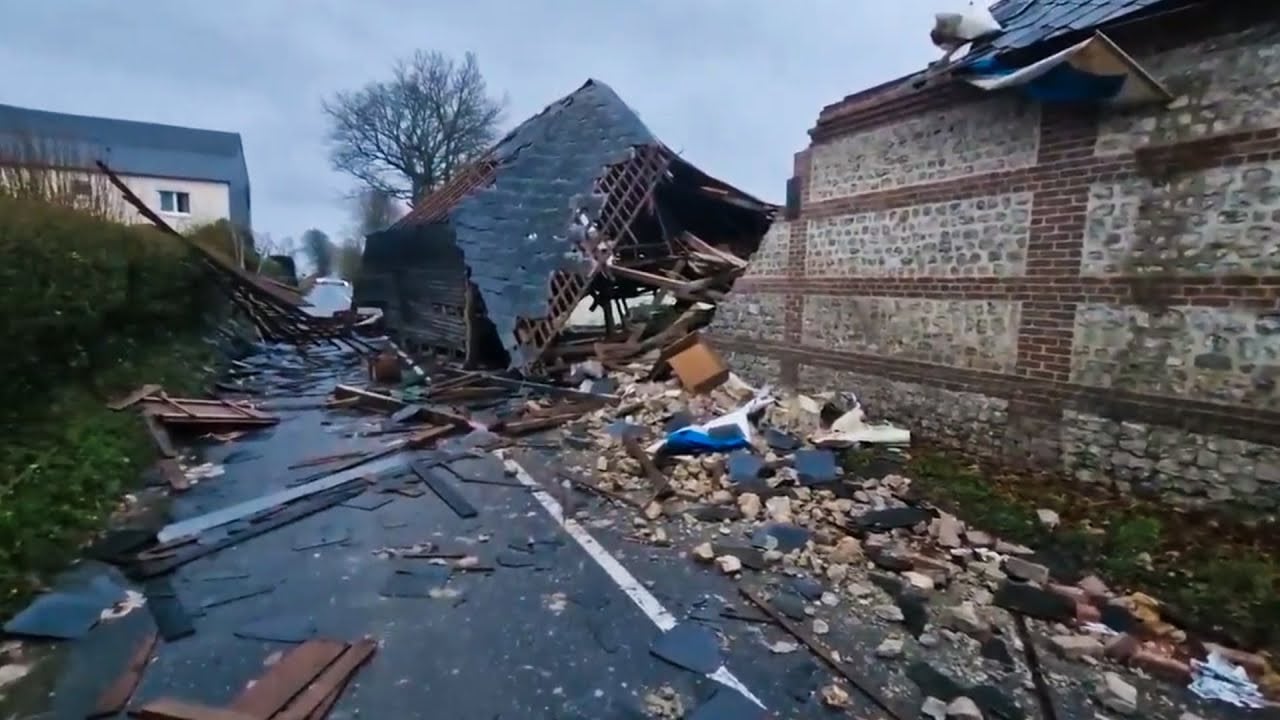
On January 8, Storm Goretti struck Europe. It brought severe weather conditions, with temperatures dropping to minus 4 degrees Fahrenheit, blizzards, and winds reaching up to 124 miles per hour.
In the United Kingdom, local media described the storm as a “weather bomb.” On the Isles of Scilly and in Cornwall, the highest — red — level of danger was declared. Wind gusts reached nearly 99 miles per hour. On St Michael’s Mount, the wind knocked down approximately eighty percent of all trees. Fifty-seven thousand households were left without power. All rail services in Cornwall were suspended, and about 70 flights were canceled at Heathrow Airport. On January tenth, a deceased man was found in the county after a tree, toppled by gale-force winds, fell onto his van.
In Germany, the storm was accompanied by heavy snowfall and blizzards. In the northern part of the country, long-distance rail service came to a complete halt, and the Hanover transport hub was blocked. Multi-mile traffic jams formed on highways due to stranded trucks. The storm forced the closure of the Volkswagen plant in Emden, where approximately eight thousand people are employed. Hospitals, particularly in Hamburg, reported a sharp influx of patients with injuries. In Bavaria, three people were killed in traffic accidents on icy roads.
In the Netherlands, blizzards and snowdrifts in the north of the country, in the province of Groningen, led to the closure of several key highways, including Route N thirty-three and Route N forty-six.
In Belgium, the storm triggered hundreds of emergency calls due to fallen trees. Wind speeds reached up to sixty-two miles per hour. In the city of Waterloo, a motorcyclist sustained severe injuries after being struck by a falling branch.
In Serbia, some areas remained without electricity for several days. In Hungary, temperatures in one mountain valley dropped to approximately minus twenty-seven degrees Fahrenheit, while disruptions to rail service continued for the fifth consecutive day. In the Czech Republic, snowfall paralyzed traffic in Prague. In Romania, around four thousand homes were left without power, and in Moldova, approximately six hundred schools were forced to postpone the start of classes.
France suffered the most severe impact from the storm. During the night from January 8 to January 9, record-breaking winds were recorded along the English Channel coast. In the town of Barfleur, in the Manche department, wind gusts reached approximately 132 miles per hour. The storm left around 380,000 homes without electricity, primarily in Normandy. Thousands of trees were uprooted, roads were blocked, and flooding was recorded in coastal towns, including Étretat and Fécamp. The Port of Dieppe was closed due to storm-driven water surges. One person sustained serious injuries. Mass casualties were avoided only because the storm struck in the middle of the night, when most people were sheltering indoors.
The year 2025 set new records for climatic disasters worldwide, and, unfortunately, the current year, 2026, has inherited this trend, further intensifying the abnormality and power of the elements. Doctor Egon Cholakian explained in great detail why this is happening in his video addresses, which can be viewed on his channel. The most important question remains: how can the escalating climate crisis be stopped? The answer to this question is presented in the film “Nanoplastics. Threat to Life | ALLATRA Documentary”
Publication of this material provides an opportunity for open discussion and does not in itself imply institutional endorsement, confirmation, or scientific verification of the views expressed. The material does not constitute an official statement, expert opinion, or professional advice.