
On December 17, a powerful storm system formed in the Rocky Mountains — a major mountain range in the western United States. Moving eastward, it affected more than thirty states, bringing extreme weather conditions across the country.
In the Pacific Northwest, hurricane-force wind gusts reaching about 138 miles per hour caused widespread power outages. Hundreds of thousands of people were left without electricity, significantly worsening the impacts of recent flooding. Mass power outages were reported in Washington State, where more than 350,000 customers lost power, while in Oregon, around 200,000 people were left without electricity.
In Boulder County, Colorado, squall winds lifted dust and debris into the air, sharply reducing visibility on roadways. Local authorities urged residents to stay home and avoid travel.
In the city of Twin Falls, Idaho, two children were seriously injured after strong winds toppled trees and brought down power lines near a bus stop where they were waiting for a school bus.
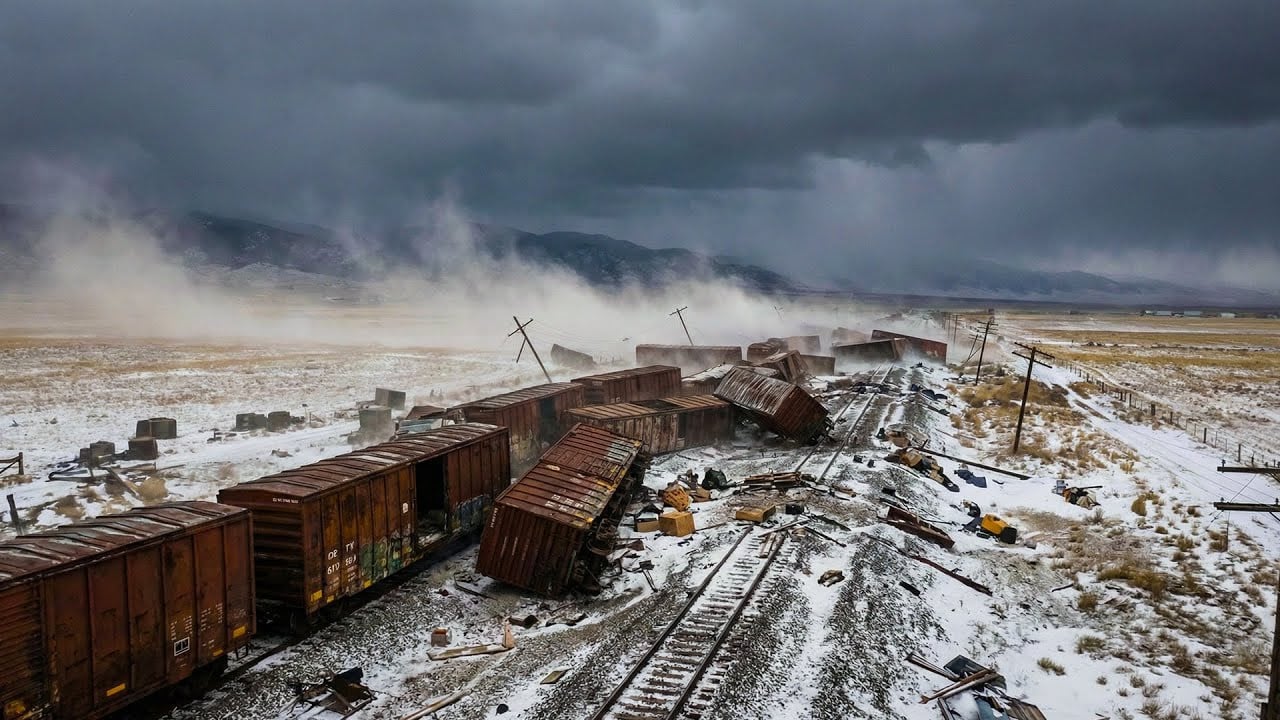
In Wyoming, the storm set a new regional wind speed record: on Coffin Mountain, gusts reached approximately 144 miles per hour. The storm overturned more than one hundred freight railcars near the state capital, Cheyenne, completely blocking rail traffic. Specialized crews needed nearly eighteen hours to clear the tracks.
Strong winds also contributed to the rapid spread of wildfires in South Dakota, Wyoming, and Colorado. In Pennington County, South Dakota, a highway was temporarily closed due to fire activity, and residents were advised to evacuate. Evacuation measures were also introduced near Cheyenne, Wyoming, as well as in Yuma County, Colorado, where the fire burned more than 40,000 acres.
Across the Northern Plains and central regions of the country, the storm brought heavy snowfall and blizzard conditions. In some areas, snowdrifts formed and “whiteout” conditions developed, leaving drivers with almost no visibility. Torrential rains moved into the Central Plains and the Mississippi and Ohio River valleys, causing traffic disruptions and flight delays.
The storm reached the northeastern United States on the night of December 26th. Heavy rainfall and wind gusts of up to about 68 miles per hour disrupted operations at major airports and significantly complicated travel during the Christmas and New Year holiday period.
The United States has experienced severe winter storms before, but in recent years — and especially noticeable in 2025 — they have become extraordinarily large in scale, with the intervals between such extreme events shrinking to a minimum.
Humanity must comprehensively study these changes, understand their mechanisms, and unite global efforts to find solutions. The international scientific team of ALLATRA has been researching the causes of the growing intensity of climatic and geodynamic catastrophes on the planet for a long time and is already proposing concrete, scientifically grounded practical actions to reduce their strength and scale. More details can be found in the film “Nanoplastics. Threat to Life | ALLATRA Documentary.”