
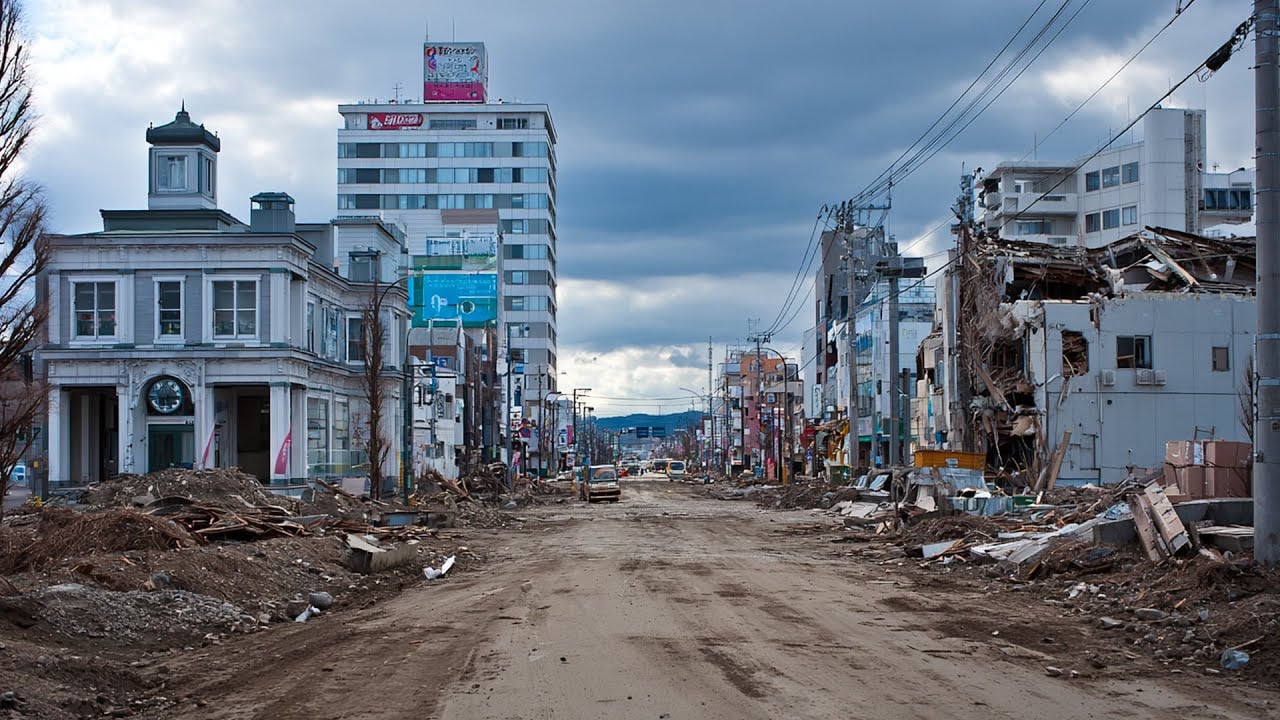
On December 6, a spike in seismic activity was recorded beneath the Hubbard Glacier. The main shock, with a magnitude of 7.0, occurred at 11:41 a.m. Alaska time. Its epicenter was located approximately 56 miles to the northeast of the city of Yakutat in the state of Alaska, United States, and about 155 miles to the west of Whitehorse, Yukon Territory, Canada. The hypocenter lay at a depth of only 6.2 miles.
Despite the strength of the quake, no tsunami warning was issued; nor were there any reports of serious destruction or casualties.
The tremors from this seismic event were felt over a considerable distance: residents of cities in southeastern Alaska — including Juneau and Anchorage — as well as in Canada’s Yukon, felt the shaking.
Following the main shock, an intense series of aftershocks began. Over the next four days, at least 230 repeated events with magnitudes of 3.0 and higher were recorded, including five strong ones with magnitudes up to 5.8.
Already on the evening of December 8 at 11:15 p.m. local time, another powerful seismic event occurred — an earthquake with a magnitude of 7.6 — about 50 miles off the eastern coast of Japan’s Aomori Prefecture. The focal depth was 31 miles. The strongest shaking was observed in the city of Hachinohe.
The earthquake generated a tsunami: in the port of Kuji in Iwate Prefecture, wave heights reached 28 inches, and in the town of Urakawa in Hokkaido — up to 20 inches.
The consequences in Aomori Prefecture were significant. 45 schools were damaged, and classes were canceled in 318 educational institutions.
In the port of Hachinohe, soil liquefaction occurred — fountains of sand and water erupted from cracked ground in a parking area. In the city hospital, three floors were flooded due to the activation of the fire-extinguishing system. Hundreds of households in the cities of Shichinohe and Mutsu were left without water and electricity.
A total of 50 people in the prefectures of Aomori, Iwate, and Hokkaido were injured, mostly due to falls and being struck by objects.
The seismic event also hit the region’s transportation system: service on the Tohoku Shinkansen high-speed rail line between Fukushima and Shin-Aomori was suspended, and three trains were stranded on the tracks.
Service was halted on several subway lines, including in Sapporo. Hokkaido expressways were temporarily closed, and ferry service across the Tsugaru Strait was also suspended. About two hundred passengers spent the night in the terminal of New Chitose Airport, the largest in Hokkaido, due to safety inspections of the runways.
Critical infrastructure was also put at risk: at the Tomato-Atsuma thermal power plant in Hokkaido Prefecture, one of the power units shut down automatically.
At the nuclear-waste reprocessing plant in the village of Rokkasho, Aomori Prefecture, about 172 gallons of water containing radioactive substances spilled from the spent fuel storage pool. The leak was promptly contained.
Within two days after the main shock with a magnitude of 7.6, at least seven powerful aftershocks occurred, with magnitudes reaching 6.6.
It must be acknowledged that seismic activity on our planet is steadily increasing, and earthquakes with high magnitudes have already become more frequent. At the same time, there is a factor that is still hardly considered by anyone in the scientific community. It exacerbates the geodynamic crisis and intensifies natural disasters by hindering the release of heat from the planet’s interior. This concerns micro- and nanoplastics. This process is described in detail in the report “NANOPLASTICS IN THE BIOSPHERE. FROM MOLECULAR IMPACT TO PLANETARY CRISIS.”