
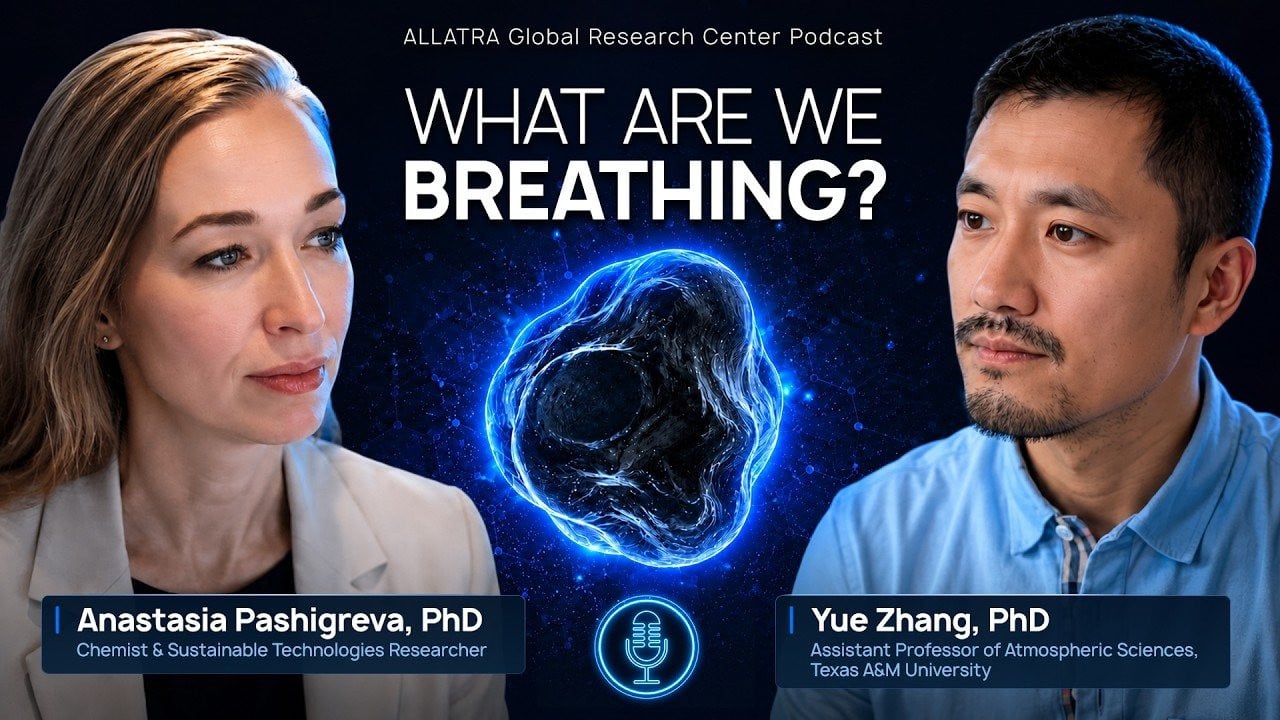
The atmosphere is one of Earth's most dynamic and least visible systems. Alongside gases that sustain life, it carries microscopic particles that affect air quality and transport pollutants, including micro- and nanoplastics.
In this episode of the ALLATRA Global Research Center Podcast, Dr. Anastasiya Pashigreva speaks with Dr. Yue Zhang, Assistant Professor of Atmospheric Sciences at Texas A&M University and recipient of the NSF CAREER Award. Dr. Zhang's research focuses on atmospheric chemistry, aerosols, air quality, and the emerging science of airborne micro- and nanoplastics. Using advanced laboratory techniques and real-time atmospheric measurements, his team investigates how these microscopic particles are transported through the atmosphere and why understanding them has become an important scientific challenge.
Rather than focusing only on what we already know, this conversation explores the questions scientists are still working to answer — from identifying the major sources of airborne microplastics to understanding their distribution, transport, and potential impacts on climate and human health.
In this episode:
- The science behind atmospheric aerosols and why they matter
- How airborne micro- and nanoplastics are measured in real time
- The most likely sources of microplastics in the atmosphere
- Indoor vs. outdoor exposure — what current research suggests
- Mobile atmospheric laboratories and field measurements
Learn more about Dr. Yue Zhang's research:
https://artsci.tamu.edu/atmos-science/contact/profiles/yue-zhang.html
Report of the ALLATRA Global Research Center “Nanoplastics. A Systematic Risk Analysis for Human Health, Ecosystems, and the Environment”
https://allatra.org/global-research-center/publications/agrc.report.mnp.2026.04001
The podcast is hosted on the ALLATRA Global Research Center platform.
This material is for informational and discussion purposes only. The statements, assessments, interpretations, conclusions, and hypotheses contained herein represent personal views of their authors as of the date of publication and do not constitute an official stance of the ALLATRA international organization or any other public association, organization, project, partner, or affiliated entity or person, unless expressly stated otherwise.
Publication of this material provides an opportunity for open discussion and does not in itself imply institutional endorsement, confirmation, or scientific verification of the views expressed. The material does not constitute an official statement, expert opinion, or professional advice.
Publication of this material provides an opportunity for open discussion and does not in itself imply institutional endorsement, confirmation, or scientific verification of the views expressed. The material does not constitute an official statement, expert opinion, or professional advice.