
Detecting micro- and nanoplastics is one of the greatest scientific challenges in environmental and biomedical research. As these particles become smaller, they become increasingly difficult to identify, measure, and distinguish within complex biological and environmental systems. Developing reliable detection technologies is an essential step toward understanding where these particles are found, how they interact with living systems, and how future monitoring strategies can be improved.
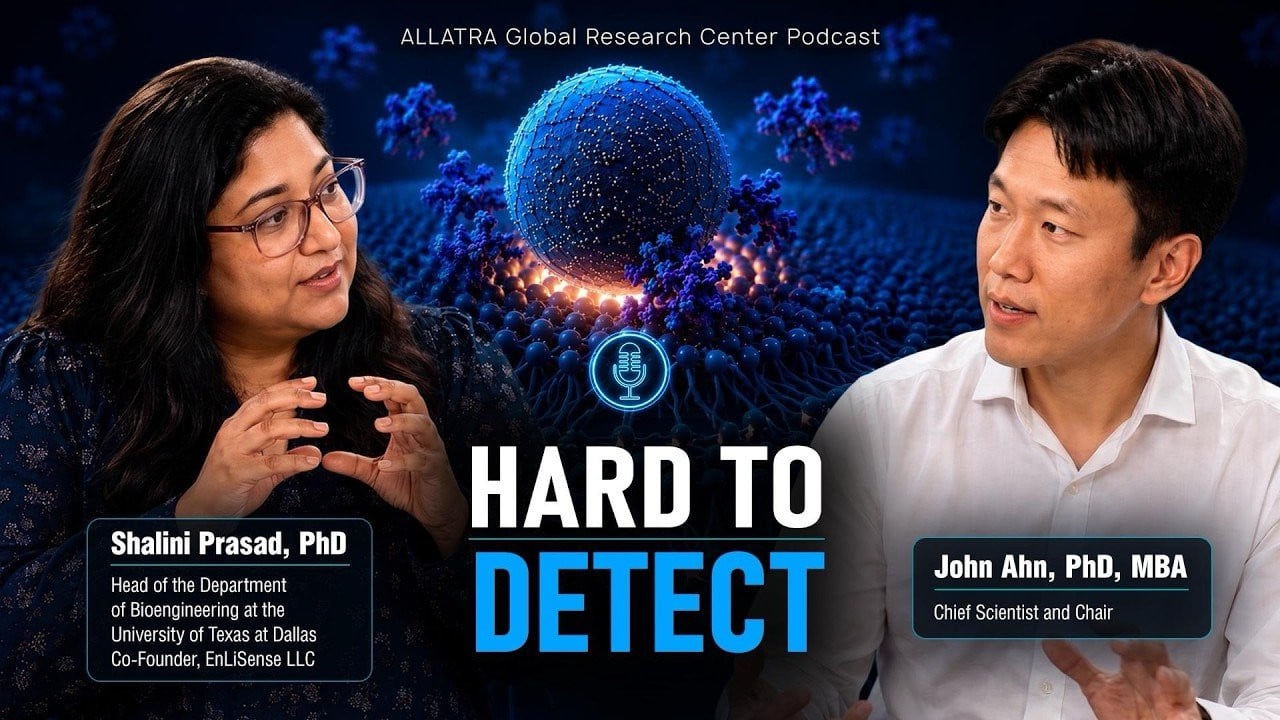
In this episode of the ALLATRA Global Research Center Podcast, Dr. John Ahn speaks with Dr. Shalini Prasad, Professor and Department Head of Bioengineering at The University of Texas at Dallas. A pioneer in biosensors, electrochemical diagnostics, and nanotechnology, Dr. Prasad explores how advances in biosensing, electrochemical impedance spectroscopy, and materials science are opening new possibilities for detecting micro- and nanoplastics in water, food, biological fluids, and environmental samples.
The conversation highlights the science behind next-generation detection technologies for micro- and nanoplastics, exploring the engineering principles, analytical challenges, and emerging approaches that could improve future environmental and biomedical monitoring.
In this episode:
Why detecting nano-sized plastics remains one of the key analytical challenges
How electrochemical impedance spectroscopy can identify micro- and nanoplastics
Why particle size, charge, and morphology influence biological interactions
Emerging biosensor technologies for environmental and biomedical monitoring
From laboratory research to real-world applications: what it takes to commercialize scientific innovations
Future opportunities for large-scale monitoring of micro- and nanoplastics
Learn more about Dr. Shalini Prasad's research:
https://profiles.utdallas.edu/shalini.prasad
Report of the ALLATRA Global Research Center
Nanoplastics. A Systematic Risk Analysis for Human Health, Ecosystems, and the Environment
https://allatra.org/global-research-center/publications/agrc.report.mnp.2026.04001
The podcast is hosted on the ALLATRA Global Research Center platform.
This material is for informational and discussion purposes only. The statements, assessments, interpretations, conclusions, and hypotheses contained herein represent personal views of their authors as of the date of publication and do not constitute an official stance of the ALLATRA international organization or any other public association, organization, project, partner, or affiliated entity or person, unless expressly stated otherwise.
Publication of this material provides an opportunity for open discussion and does not in itself imply institutional endorsement, confirmation, or scientific verification of the views expressed. The material does not constitute an official statement, expert opinion, or professional advice.
Timestamps:
00:00 In This Episode
00:35 Introduction: Dr. Shalini Prasad
01:19 From Electrical Engineering to Bioengineering
03:27 The Evolution of Biosensing Technology
06:12 Why Size, Charge & Shape Matter at the Nanoscale
09:54 How Do We Detect and Characterize Nanoparticles?
15:32 What Happens to Nanoparticles Inside the Body?
18:19 The Challenge of Analyzing Particles in Biological Environments
22:49 Microplastics & Nanoplastics: What Makes Them Different?
24:16 How Microplastics Can Affect the Human Body
26:16 Can We Reduce the Harm Caused by Microplastics?
29:16 The Future of Microplastic Detection & Biosensing
33:20 From the Lab to the Real World: Scaling New Technologies
37:15 Final Takeaway: Turning Research Into Public Impact
Publication of this material provides an opportunity for open discussion and does not in itself imply institutional endorsement, confirmation, or scientific verification of the views expressed. The material does not constitute an official statement, expert opinion, or professional advice.