
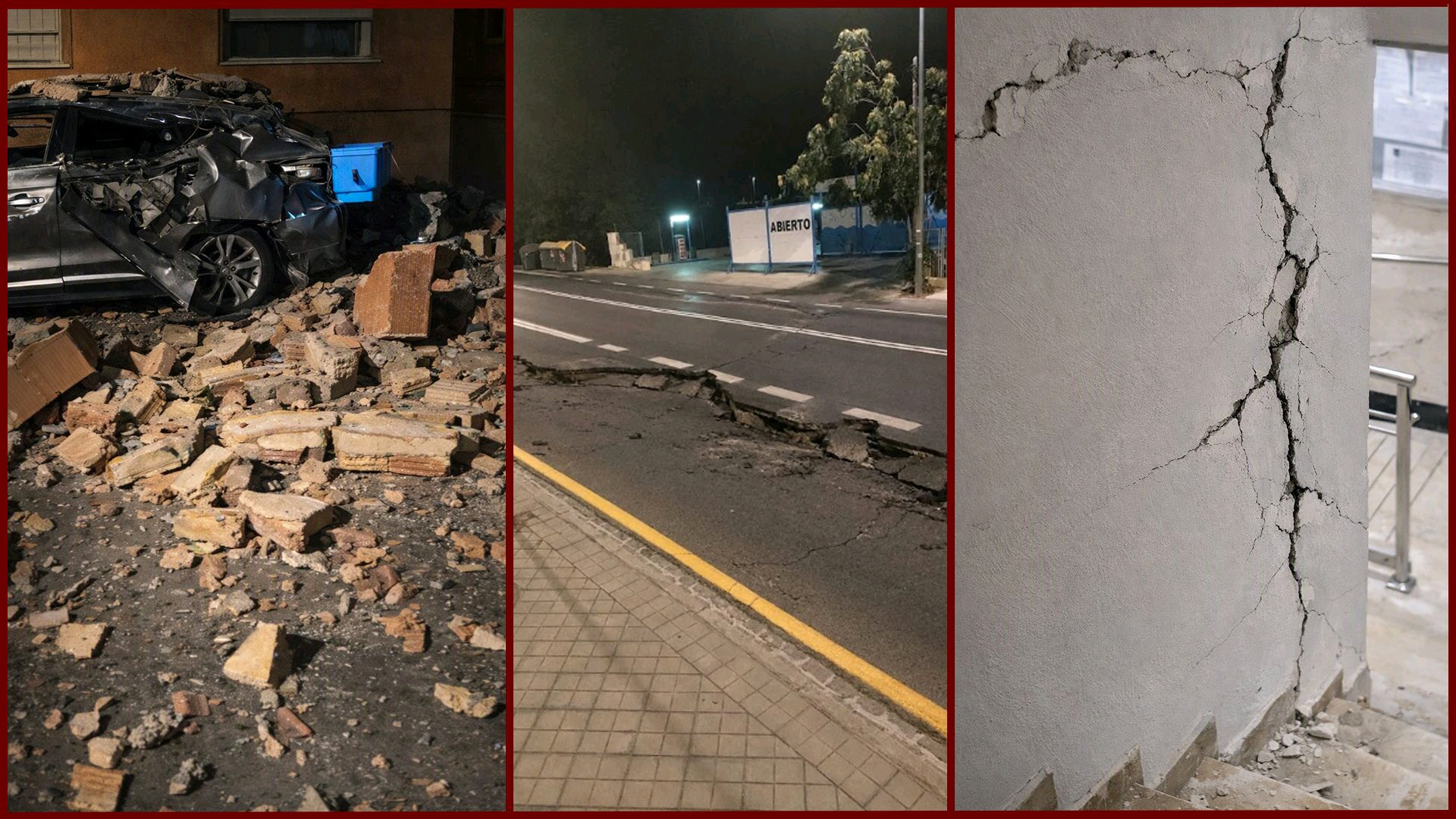
In just a few days, southern Spain was shaken twice by strong earthquakes.
On the night of August 15, at 1:04 a.m. local time, a magnitude 4.8 earthquake struck northeast of the municipality of Alhendín in the province of Granada. Its focus was located practically at the surface — Spain’s National Geographic Institute determined the depth to be zero miles.
The shallow depth significantly intensified the shaking in the epicentral area. The tremors were felt across a vast territory, in approximately five hundred communities, not only in Granada and other parts of central and eastern Andalusia, but also in Murcia, Castilla-La Mancha, and even in the southern part of the Autonomous Community of Madrid.
After the earthquake, people left their homes in large numbers. Objects fell inside apartments, cracks appeared, and plaster crumbled.
Cornices, chimney elements, and other non-load-bearing structures broke away from building facades. In some buildings, deformation caused doors to become jammed, so some residents needed assistance to get outside.
Public buildings were also damaged. In the city of Granada itself, interior damage was found in five Catholic churches. At the same time, after the first strong earthquake, no serious damage to load-bearing structures was generally identified.
Seismologists paid particular attention to the parameters of ground motion. An accelerograph in Armilla, located about 1.9 miles from the epicenter, recorded ground acceleration equal to 24.6% of gravitational acceleration, while the maximum ground velocity reached approximately 3.2 inches per second. For an earthquake of this magnitude, these values were unusually high.
At first, the sequence of events appeared fairly typical: a strong mainshock followed by a gradually decaying sequence of aftershocks. However, on the morning of August 18, this pattern changed.
At 10:37 a.m. local time, another earthquake occurred northwest of the municipality of Villa de Otura. After the data were refined, its magnitude was also determined to be 4.8, while the focal depth was estimated at approximately 4.3 miles.
It was the second magnitude 4.8 earthquake that prompted seismologists to reconsider their initial interpretation of what was happening. A specialist from the University of Granada stated that the events should now be regarded as a seismic sequence.
More noticeable tremors followed. On August 18 alone, four earthquakes with magnitudes of about four or higher were recorded.
The second strong earthquake worsened the impact on infrastructure that had already been damaged three days earlier. Existing cracks in buildings widened, while weakened facade elements began to crumble. Three people sustained minor injuries, and one injured minor was taken to a hospital.
The situation was particularly serious in the municipality of Las Gabias. Around 600 people were evacuated there as a safety precaution. Authorities later reported that some buildings had more than just superficial defects: emergency services had to reinforce damaged columns.
Against the backdrop of changing climate conditions, it is useful to understand in advance which natural hazards are typical for your region and how to act if the situation becomes dangerous. Simple preparedness measures — knowing the basic recommendations and keeping a small supply of essential items at home — can prove very important in an emergency.
Follow updates from local authorities and take care of yourself and your loved ones. Human life is the highest value.
Publication of this material provides an opportunity for open discussion and does not in itself imply institutional endorsement, confirmation, or scientific verification of the views expressed. The material does not constitute an official statement, expert opinion, or professional advice.