
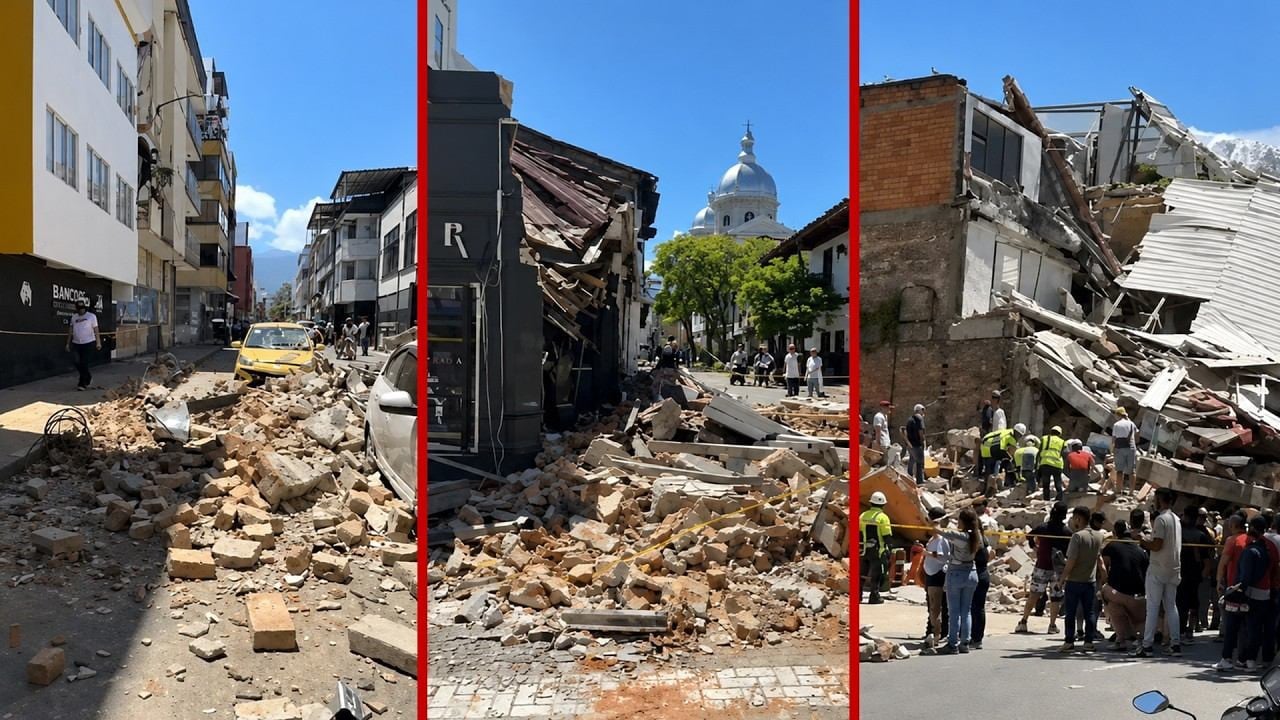
The morning of August 10 began for Colombia with one of the strongest earthquakes in its history. At 7:34 a.m. local time, a magnitude 7.4 earthquake struck the western part of the country, in the area of the municipality of San José del Palmar in the Chocó Department. The focus was located at a depth of approximately sixty-four miles.
According to the Director General of the Colombian Geological Service, by magnitude this earthquake became the third strongest ever recorded in the country.
Despite the considerable depth of the focus, the shaking was felt across almost all of Colombia. The Geological Service received more than 20,000 reports from over 1,200 communities. Cali, Pereira, Manizales, Quibdó, and a number of smaller municipalities were seriously affected.
In the first minutes after the earthquake, the streets filled with people leaving their homes, offices, and shopping centers. In some hospitals, patients were urgently evacuated from the buildings. In places where structures failed, survival sometimes depended on a matter of minutes: some people were found in intact sections of collapsed buildings, while others were pulled from beneath the rubble by neighbors even before emergency services arrived.
Firefighters, the Red Cross, civil defense teams, and search-and-rescue dog units quickly joined the search operation. Heavy machinery was deployed to clear the largest piles of debris.
But as more information came in, it became clear that the destruction was not localized. The earthquake affected 15 of the country’s 32 departments. More than 81,500 homes were damaged, and around 14,500 were completely destroyed. Tens of thousands of families are now effectively without a place to live. Along with residential buildings, churches, historic sites, municipal facilities, restaurants, and small businesses were also damaged.
The earthquake affected virtually every part of the infrastructure. Damage was recorded at 241 medical facilities, more than 2,600 educational facilities were affected, as well as over 3,600 community centers. Nearly 300 roads, 44 road bridges, and five airports were damaged.
The situation became especially severe in the Chocó Department, one of the poorest regions of Colombia. Many residents whose homes were destroyed lost nearly all of their belongings and were left with only what they were wearing at the moment the earthquake struck.
The scale of the recovery ahead is enormous. On August 18, the country’s president said that preliminary economic losses were estimated at approximately 9.6 billion dollars.
According to official data as of August 15, 294 people were killed, nearly 4,000 were injured, and another 320 were still listed as missing.
At the same time, the search operations continued to bring good news as well: 353 people were found beneath the rubble and rescued alive.
For hundreds of families, these rescues became the most important outcome of the first days after the disaster.
Natural disasters like this remind us once again how important it is to be prepared for such a sudden emergency and to know how to act. Having this knowledge and a clear plan of action in mind can help you avoid panic and, in a critical situation, may save your own life or the life of someone near you.
Remember that human life is the highest value.
Publication of this material provides an opportunity for open discussion and does not in itself imply institutional endorsement, confirmation, or scientific verification of the views expressed. The material does not constitute an official statement, expert opinion, or professional advice.