
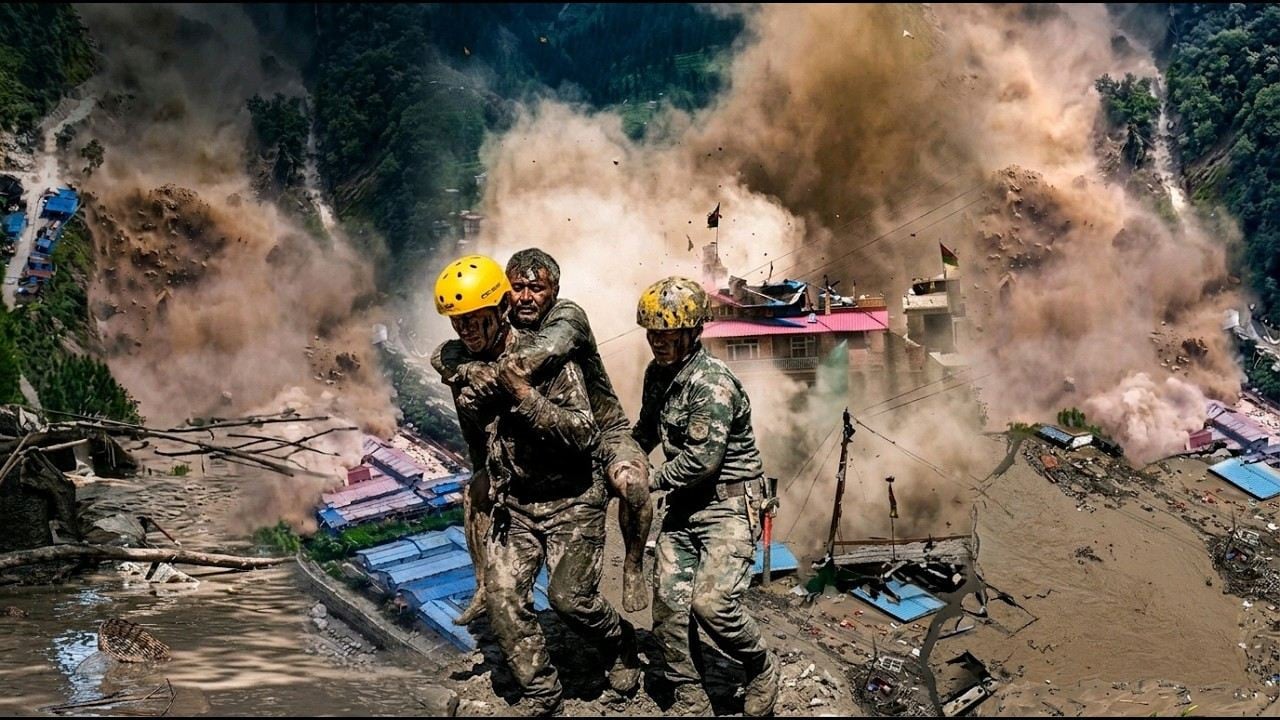
On the morning of August 26, a massive collapse of glacier ice and rock occurred high in the Himalayas, near the Nepal-China border, in the headwaters of the Lhende Khola River.
At an elevation of about 17,060 feet, an enormous mass roughly 1,970 feet wide broke away from the slope and plunged nearly 3,940 feet into the valley below.
The force of the impact was tremendous. According to an estimate by the United States Geological Survey, the energy released by the collapse was comparable to that of a magnitude 5.2 earthquake.
Ice and rock debris surged rapidly down the steep slope, sweeping up soil, boulders, and water along the way. As it moved, the mass of ice shattered and melted rapidly. This created a powerful debris flow that destroyed everything in its path. A huge wave of water and mud, resembling a tsunami, overtook hundreds of people who were trying to flee.
The bodies of victims were later found far downstream, hundreds of miles from the area where the disaster began.
In many places, events unfolded in a matter of seconds. One eyewitness from the village of Shanti Bazaar in Nuwakot District said residents had about twenty seconds before the surge of water and mud rose to approximately twenty feet. People rushed up the slopes. He and other survivors managed to reach a hill, where they remained for more than forty-eight hours waiting for help.
In the village of Trishuli Bazaar, a timely warning helped save more than one thousand six hundred people. After learning that the flow had already destroyed a village upstream, a school principal immediately raised the alarm. Teachers were instructed to take the children to higher ground, while drivers of school buses that were still on the road were warned by phone.
Among the facilities most severely affected were hydropower plants in the Trishuli Valley. According to the Independent Power Producers’ Association of Nepal, thirteen facilities were damaged, and contact with more than nine hundred workers was lost after the disaster struck.
One evacuated employee said that at least four hundred people had been present at his worksite alone and that, according to him, there were more fatalities than survivors.
At the time of the disaster, large numbers of tourists and pilgrims were also in the border region. Routes through this area lead to sacred destinations including Mount Kailash and Lake Manasarovar in Tibet, as well as Lake Gosaikunda, which attracts thousands of pilgrims during the pilgrimage season.
Among those who escaped was a group of fifty-seven pilgrims from the Indian state of Tamil Nadu. After leaving their bus, the group began climbing the slope. One woman unwound her sari so that her husband could use the fabric as an improvised rope to help several elderly people climb to safety.
In Nepal, around five hundred ninety foreign nationals from 39 countries were listed as missing.
According to Nepal Police data as of September 2, the deaths of 1,127 people had been confirmed in the country. Nearly 4,860 more people remained missing or could not be contacted.
Hundreds of people suffered various injuries. According to Nepal’s Ministry of Foreign Affairs, as of September 1, 11,800 people had been rescued.
The disaster also had serious consequences on the Chinese side of the border. According to official data from the Tibet Autonomous Region, by August 30, sixteen deaths had been confirmed there, while another 546 people remained listed as missing.
Particularly extensive destruction occurred in the border county of Gyirong. According to Chinese experts, the ice-and-rock debris flow traveled approximately thirteen point seven miles from the collapse site to the border crossing area in just a few minutes. Dozens of buildings and surrounding structures were completely destroyed. Road transportation, electricity supplies, and communications were disrupted.
According to a satellite assessment, in Nepal alone, the disaster completely destroyed at least twenty-four bridges, more than thirty-one miles of roads, and over two thousand five hundred buildings. One hundred ninety-five telecommunications towers were also damaged. However, mapping has not yet covered the entire disaster zone, so the final scale of the destruction remains unknown.
All of these eyewitness accounts show how much, in the first minutes of a disaster, depends on how people themselves react. When there is no time to wait for help, having at least a basic action plan thought through in advance can make all the difference — knowing what to do, where to go, and how to help those around you. In a critical moment, this kind of preparation can save your life and the lives of your loved ones.
Publication of this material provides an opportunity for open discussion and does not in itself imply institutional endorsement, confirmation, or scientific verification of the views expressed. The material does not constitute an official statement, expert opinion, or professional advice.