
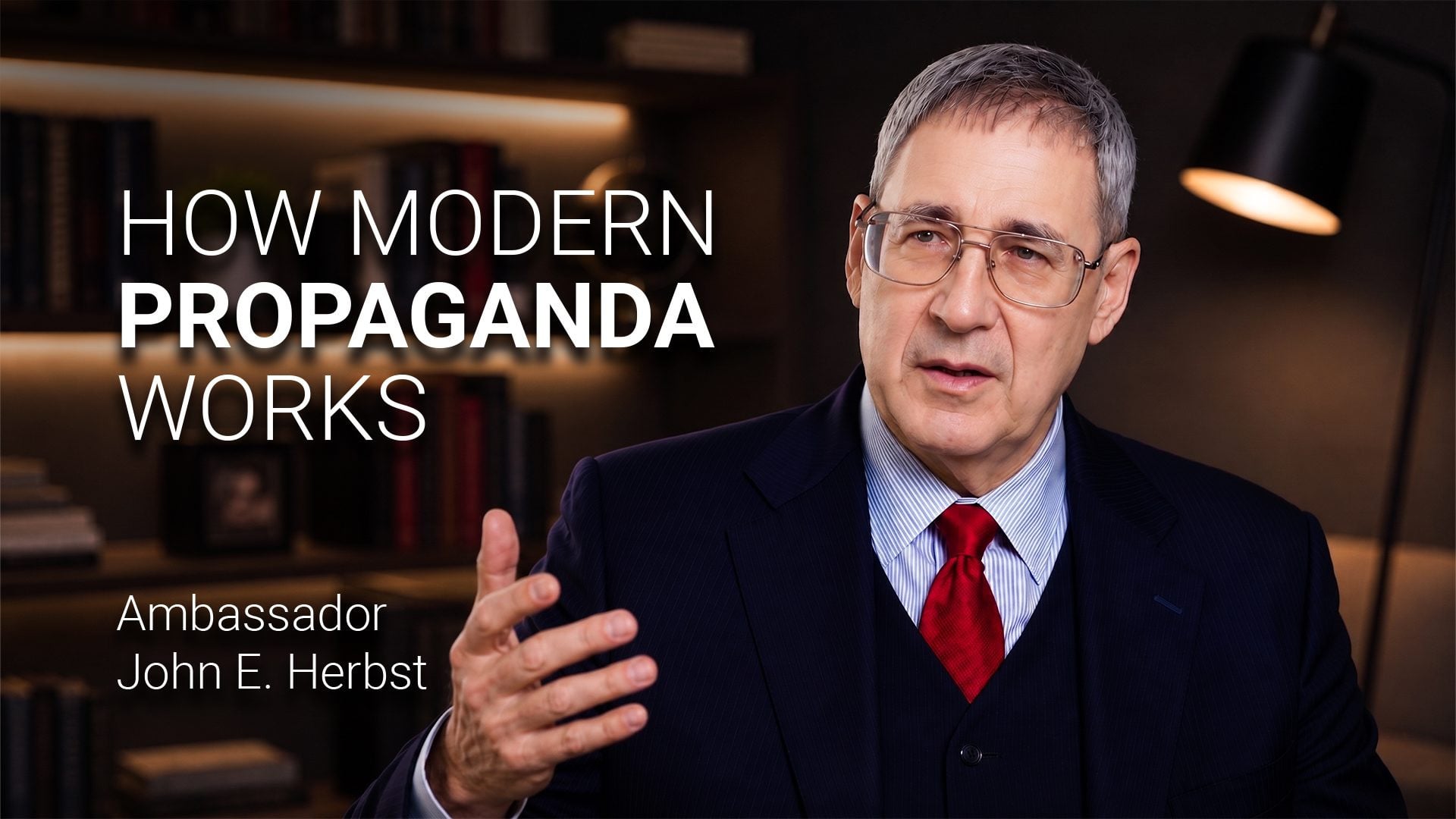
How does modern disinformation work? Why are democratic societies vulnerable to information warfare? And can a nation be weakened without a single shot being fired?
In this in-depth conversation, Ambassador John E. Herbst, one of America's most distinguished diplomats and leading experts on Ukraine, Russia, Eurasian security, and hybrid warfare, explores the evolving nature of propaganda, disinformation, and foreign influence operations in the twenty-first century.
Ambassador John E. Herbst, one of the highest distinctions in the United States Foreign Service, served as U.S. Ambassador to Uzbekistan during a period of growing strategic importance for Central Asia and later as U.S. Ambassador to Ukraine during the Orange Revolution, a defining moment in the country's democratic development.
At the U.S. Department of State, Ambassador John E. Herbst served as Coordinator for Reconstruction and Stabilization, leading U.S. civilian efforts to assist countries emerging from conflict and instability. He also served as Director of the Center for Complex Operations at the National Defense University, helping strengthen cooperation among diplomatic, civilian, and military institutions in addressing international crises.
Today, Ambassador John E. Herbst serves as Senior Director of the Atlantic Council's Eurasia Center.
Drawing on more than three decades of diplomatic service, Ambassador Herbst discusses how information has become a strategic instrument of power, why modern Russian disinformation differs from traditional propaganda, and how influence campaigns seek not only to shape opinions but also to erode public trust in institutions, facts, and objective truth itself.
Among the key topics discussed:
• Ambassador Herbst's diplomatic career and his journey toward studying disinformation and influence operations
• Why the erosion of trust in truth has become a central objective of modern information warfare
• The evolution of propaganda from the twentieth century to today's digital age
• The strategic goals of Russian disinformation and its impact on democratic societies
• Vulnerabilities in the United States and Europe and how democracies can build resilience
• Information warfare as a national security challenge
• Lessons from Ukraine's experience confronting Russian influence operations
• How Russia's full-scale invasion of Ukraine has changed Western thinking about deterrence, alliances, and security
• The concept of "narrative laundering" and how disinformation moves from fringe spaces into mainstream discourse
• The continuing relevance of George Kennan's "Long Telegram" and the importance of societal resilience in confronting foreign influence
Ambassador Herbst also reflects on how hybrid warfare has transformed traditional understandings of national security and why information operations have become a critical component of modern geopolitical competition.
Publication of this material provides an opportunity for open discussion and does not in itself imply institutional endorsement, confirmation, or scientific verification of the views expressed. The material does not constitute an official statement, expert opinion, or professional advice.