
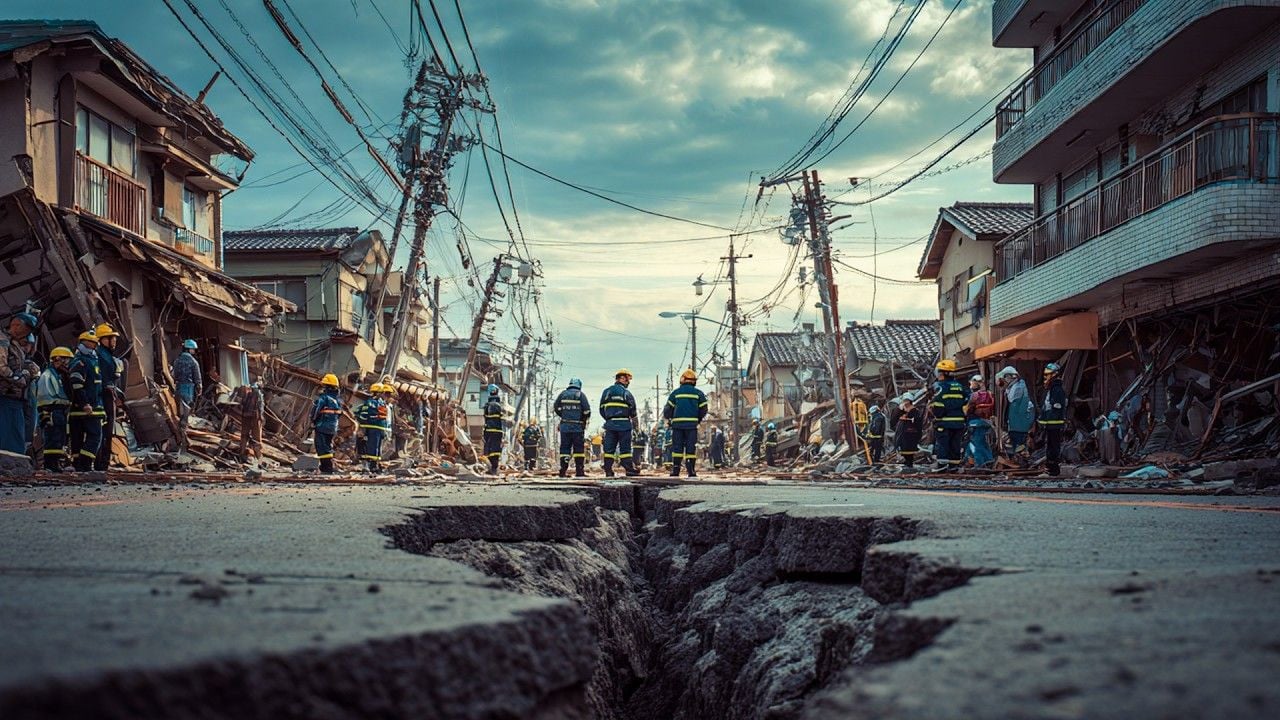
On April 20 at 4:53 p.m. local time, a powerful magnitude 7.4 earthquake struck in the Pacific Ocean off the coast of Sanriku, Japan. The hypocenter was located at a depth of about 12 miles.
The tremors were felt across a vast area — from the northeastern part of Honshu to Hokkaido. The strongest shaking was recorded in the town of Hashikami in Aomori Prefecture. The maximum intensity reached level five plus on the Japanese scale, corresponding to strong shaking capable of causing structural damage.
Despite the strength of the event, the consequences were relatively limited: dozens of buildings were damaged, and disruptions occurred in transportation, including the suspension of high-speed Shinkansen trains and temporary road closures. About ten people were injured.
Immediately after the earthquake, a tsunami warning was issued for waves of up to ten feet; however, actual wave heights were lower — around two and a half feet in ports of Iwate Prefecture. In the first minutes following the quake, national television broadcasts urgently called on residents of coastal areas to evacuate immediately. In total, more than one hundred seventy thousand people received evacuation advisories.
On the same day, the Japan Meteorological Agency issued an information advisory about an increased likelihood of additional tremors. It covered one hundred eighty-two municipalities across seven prefectures — from Hokkaido to Chiba Prefecture. According to specialists, the probability of an earthquake of magnitude 7.8 or higher under such conditions is about one percent — roughly ten times higher than the normal level.
It is worth noting that over the past ten years, the region had been characterized by consistently low seismicity — the number of earthquakes with an intensity above one on the Japanese scale generally did not exceed five to fifteen events per month. However, at the end of 2025, a sharp increase in seismic activity was recorded: the number of tremors rose to sixty or more events per month, and this elevated level continues to this day.
The increase in seismic activity on the planet, not only in such seismically active regions as Japan, is already noticeable even to non-specialists. Such a development was predicted by scientists from the international scientific group ALLATRA, which has been repeatedly presented to the global public at forums and in individual video addresses by Dr. Egon Cholakian, one of the representatives of this scientific collective. https://youtu.be/8WGubs29zGo
We recommend that you familiarize yourself with this information in order to understand how natural disasters may develop in the coming years and what can be done to protect yourself and your loved ones.
Publication of this material provides an opportunity for open discussion and does not in itself imply institutional endorsement, confirmation, or scientific verification of the views expressed. The material does not constitute an official statement, expert opinion, or professional advice.