
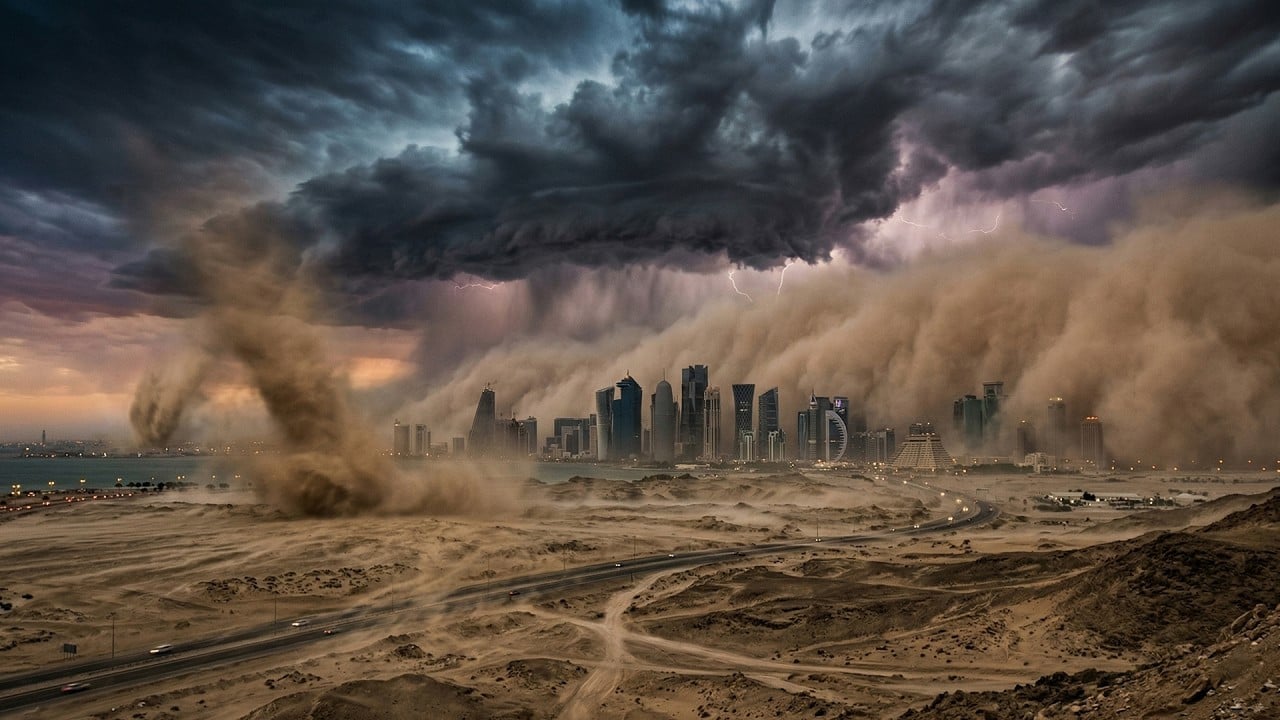
At the end of March, countries in the Middle East were affected by a series of extreme storm systems.
In Qatar, storm activity began on March 23 and was accompanied by intense precipitation, squally winds, and hail. In the city of Ras Laffan, home to the world’s largest liquefied natural gas production complex, a total of 82.1 millimeters of precipitation fell between March 23 and March 25, compared to an average annual norm of about 70 millimeters.
Heavy rainfall also impacted other parts of the country. In Al Wakrah, more than a year’s worth of precipitation fell within a single day — 87.5 millimeters of rain compared to an annual average of 62 millimeters. This level of precipitation resulted in widespread flooding of residential areas and disruption of key transportation infrastructure. Emergency response operations were launched to deal with the aftermath: over 68 hours of continuous work, services pumped out more than 480,000 cubic meters of rainwater.
At nearly the same time, adverse weather conditions spread across Saudi Arabia. In the northern region of Al Jawf, heavy rain with hail was recorded, and on March 26, similar conditions were observed in the Tabuk area. On Jabal Al Lawz, temperatures dropped below 32 degrees Fahrenheit, and snowfall was recorded — an extremely rare phenomenon for this region at this time of year.
On March 25, a powerful storm system reached the United Arab Emirates. Torrential rains caused wadis — dry riverbeds typical of desert regions that fill with water only during periods of intense rainfall — to overflow, triggering flash floods.
The transportation situation deteriorated sharply: many vehicles were submerged, and drivers were forced to abandon them on the roads. By the night of March 27, a new wave of severe weather struck the country. Wind gusts reached 60 kilometers per hour, lifting sand and significantly reducing visibility, with heavy hail reported in some areas. The storms were accompanied by prolonged thunderstorm activity — according to eyewitnesses, lightning flashes continuously illuminated the sky for more than two hours. The severe weather caused flight delays, and in major cities — Dubai, Sharjah, and Abu Dhabi — roads and underpasses were flooded.
In Oman, heavy rains were also accompanied by thunderstorms, hail, and gusty winds. Dry riverbeds quickly filled with water, leading to flash flooding. Disruptions were recorded in communications as well as in electricity and water supply systems.
The province of Musandam was the hardest hit, with emergency services receiving more than 1,400 calls. In several areas, roads became impassable, and residents were trapped in their homes. Authorities shifted most provinces to remote work and established 161 shelters for evacuees. As of March 29, at least twelve people had lost their lives.
From March 27, heavy rains and flooding also affected Yemen. Floodwaters and mud inundated residential areas and caused significant damage to infrastructure: 114 homes were completely destroyed, and another 716 were damaged. More than one thousand families were left homeless, and many roads were either flooded or blocked by debris.
In Aden, the country’s temporary capital, traffic on major highways was paralyzed for several hours. The most severe situation developed in Taiz province, where floods inundated several villages. Mudflows damaged the historic Al-Gharafi Mosque in the Al-Mokha district — one of the region’s significant cultural and religious sites. In addition, agricultural lands were destroyed, and a large number of livestock perished.
Rescue operations were significantly hampered by ongoing precipitation and damaged infrastructure: access to several areas remained limited due to strong currents and high water levels. As of March 29, the death toll had reached at least 17 people, with five more reported missing.
According to experts, such weather phenomena are more typical of the so-called Tornado Alley in the United States and are not characteristic of regions dominated by an arid desert climate. The reasons why such anomalous natural events have been observed on the planet in recent years, and what triggers them, were explained in a scientific video report by Dr. Egon Cholakian - https://youtu.be/8WGubs29zGo
Publication of this material provides an opportunity for open discussion and does not in itself imply institutional endorsement, confirmation, or scientific verification of the views expressed. The material does not constitute an official statement, expert opinion, or professional advice.