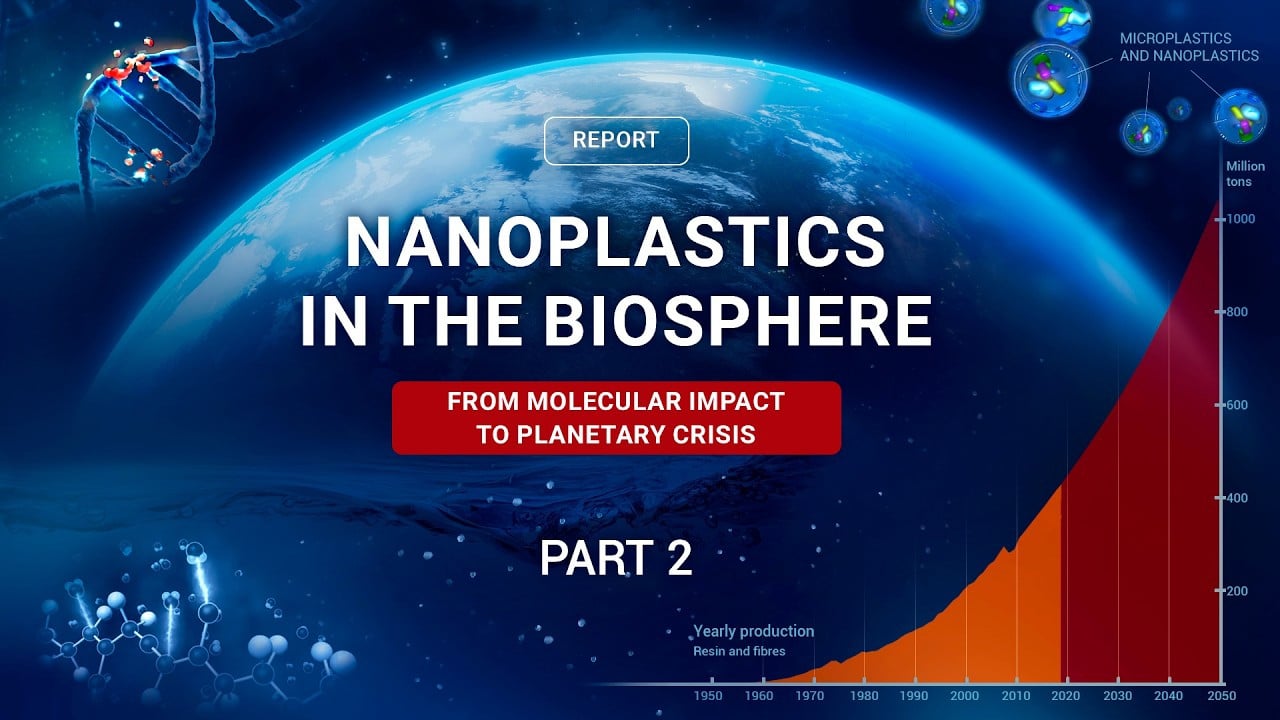
Plastics do not decompose. Hence, they don't disappear without a trace. Over time, they transform into micro- and nanoparticles that become part of the environment. Consequently, plastic pollution takes on a new dimension: it's no longer just visible garbage, but a factor capable of influencing natural processes at a fundamental level.
The second part of the report audio version examines how, after accumulating in soil, micro- and nanoplastics alter its structure and water regime and affect microorganisms, plants, and animals. Particular attention is paid to pollinators, primarily bees whose health directly affects the sustainability of ecosystems and agricultural production.
The report also emphasizes the climate aspect, examining plastics not only as environmental pollutants, but also as a factor that can influence physical properties of water, including its thermal conductivity and heat capacity, and therefore the ocean's heat balance and, consequently, climate processes. Micro- and nanoplastic particles are becoming a factor in environmental and climatic changes that directly affect everyone.
Report audio version. Part 2.
ENVIRONMENTAL AND CLIMATE CONSEQUENCES OF MICRO- AND NANOPLASTIC POLLUTION
Time codes:
0:00 Intro
0:30 How MNPs disrupt ecosystems at the molecular level
1:27 Impact of MNPs on soil properties and ecosystems degradation
5:10 MNPs in food products
11:10 Forests as global accumulators of microplastics
12:39 How nanoplastics destroy fauna
15:50 Transfer of MNPs via food chains from plankton to humans
18:14 Plastics kill marine organisms
20:20 Corals under threat: micro-threat of global scale
21:39 Impact of MNPs on the oxygen balance in ecosystems
IMPACT OF MICRO- AND NANOPLASTICS ON THE CLIMATE
26:37 Ocean functions
28:10 Changing ocean temperature patterns
31:45 Why is the ocean warming? Hypothesis
33:29 Fundamental properties of water
37:42 Influence of water properties on climate and ecosystems
38:11 Role of MNPs in altering seawater’s physical properties
40:32 Areas of micro- and nanoplastics concentration in the ocean
41:43 Link between the MNP electrostatic charge and atmospheric phenomena
43:43 Electric charges in clouds
47:24 Impact on cloud formation and precipitation
49:12 Role of MNPs in disrupting Earth’s climate balance
51:51 Interaction between the ocean and Earth’s magnetic field
The scientific report “Nanoplastics in the Biosphere: From Molecular Impact to Planetary Crisis” warns of a new global threat.
Report authors: ALLATRA International Public Movement
In collaboration with the Bolivian Catholic University San Pablo, Juan Misael Saracho Autonomous University (UAJMS), and the CREATIVE SOCIETY international project.
For the first time, a single document comprehensively examines data on distribution of micro- and nanoplastics in the biosphere, their penetration into food chains, and their devastating impact on human health and ecosystems.
Micro- and nanoplastics have an ability to accumulate electrostatic charge, which makes them a powerful factor in adverse impacts. This ability and their nanoscale size allow plastics not only to overcome protective barriers of organisms, but also to penetrate cells of living organisms.
The report is the outcome of a large-scale interdisciplinary analysis encompassing environmental, climatic, medical, physical, and chemical aspects of the negative impacts that micro- and nanoplastics exert on the biosphere and human health.
Read the full report “NANOPLASTICS IN THE BIOSPHERE: FROM MOLECULAR IMPACT TO PLANETARY CRISIS” at https://allatra.org/storage/app/media/reports/en/Nanoplastics_in_the_Biosphere_Report.pdf
Subscribe to follow the next important episode and share this video. In subsequent episodes of this series, we'll discuss the impact of micro- and nanoplastics on human health. You will also learn about possible solutions that can change the situation.
Publication of this material provides an opportunity for open discussion and does not in itself imply institutional endorsement, confirmation, or scientific verification of the views expressed. The material does not constitute an official statement, expert opinion, or professional advice.