
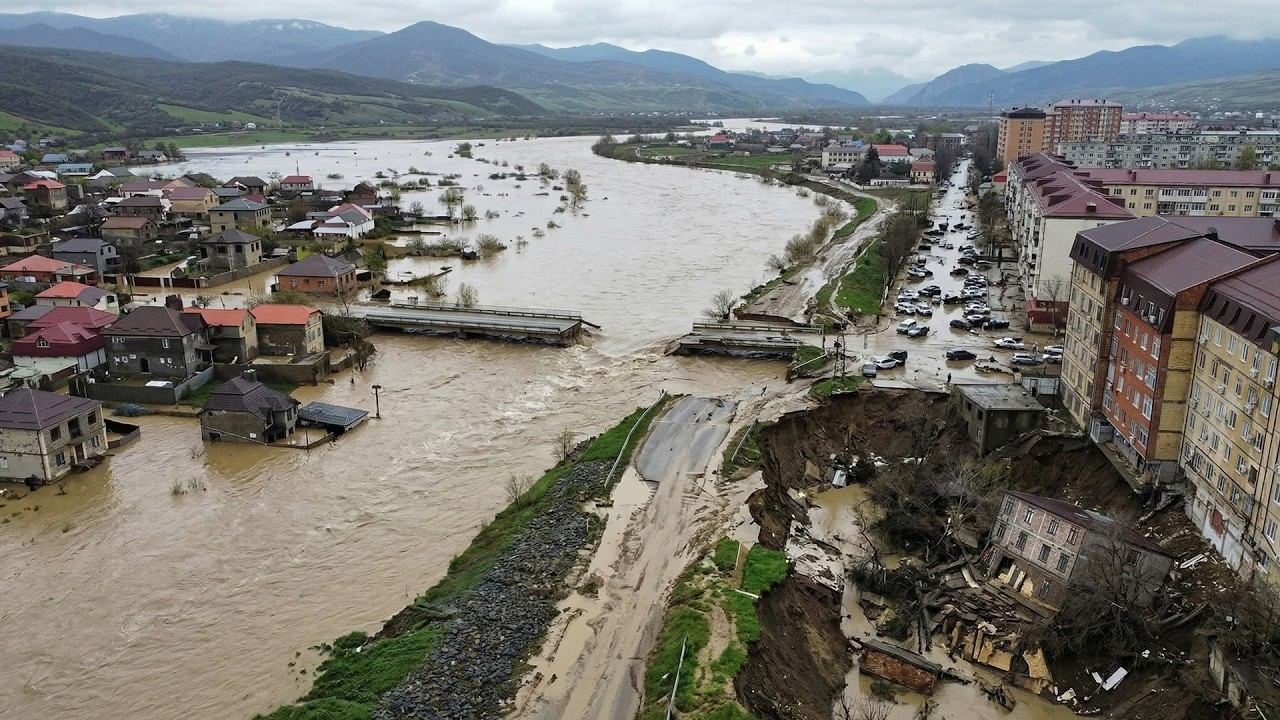
For the second week in a row, residents of the North Caucasus have been suffering from extreme precipitation that has caused widespread destruction and humanitarian consequences.
At the end of March, a vast cyclone brought torrential rains and gale-force winds to Dagestan. Beginning on March 28, the elements struck the Republic of Dagestan, triggering large-scale flooding and disruptions to water and power supply systems. At the peak of the storm, more than 500,000 residents of the republic were left without electricity, and over 3,000 people were forced to abandon their homes.
In the mountainous areas, rockfalls and mudflows occurred, disrupting transportation and leaving dozens of settlements isolated. A state of emergency was declared in five cities and seven districts of the region. In particular, emergency status was introduced in Makhachkala, Khasavyurt, Buynaksk, Dagestanskiye Ogni, and Kaspiysk, as well as in the Derbentsky, Karabudakhkentsky, Khasavyurtovsky, Gumbetovsky, Babayurtovsky, Novolaksky, and Kaitagsky districts.
Due to the erosion of their supports, two railway bridges collapsed, bringing train traffic to a halt along several sections. In the affected areas, emergency vaccination against viral hepatitis A began because of the threat of infectious disease outbreaks.
In Makhachkala, March became the rainiest on record, with 3.78 inches of precipitation — four and a half times the average monthly norm. The Khasavyurtovsky District was also severely affected, especially the villages of Adilotar, Kadyrotar, Tutlar, and Novy Tsilitl. For several days, movement there was possible only by boat, while residents were evacuated using trucks, tractors, and passenger vehicles. After rescuing people, authorities began evacuating livestock, which had remained in flooded yards for two to three days.
Additional difficulties arose due to damage to major fiber-optic trunk lines, severely limiting communications in southern Dagestan. As of April 4, 1,065 residential houses and 42 sections of highways remained flooded in the republic.
However, on the night of April 5, the elements struck the region once again. Floodwaters again affected Makhachkala, Derbent, and Dagestanskiye Ogni, as streams of muddy water inundated the streets of previously affected settlements. The highway connecting Derbent and Makhachkala was flooded, and rescuers evacuated people from danger zones using fire engines and other specialized equipment.
In Makhachkala, nearly a monthly amount of precipitation fell within a single day: on April 5, 0.7 inches were recorded, compared to the average April norm of 0.75 inches. As a result, 3,755 homes were damaged by water. Due to the subsidence of oversaturated soil, one apartment building collapsed, while four others were deemed at risk.
In Derbent, over two days, five and a half times the usual monthly rainfall fell. From April 4th to April 5th, 4.1 inches were recorded, compared to the average April norm of 0.75 inches. This led to renewed flooding of streets and residential areas.
A tragedy occurred in the village of Kirki in the Kaitagsky District, where a landslide destroyed a residential house. As a result, one person died.
In the Derbentsky District, a dam at the Gedzhukh Reservoir was breached.
For safety reasons, 4,100 people, including 823 children, were evacuated from four settlements — Mamedkala, Yuny Pakhary, Gedzhukh, and Kala.
Strong currents swept vehicles off a federal highway: seven people were rescued, but, tragically, two lost their lives.
As of April 8, the devastating floods in Dagestan had claimed six lives in total, including two children.
Anyone who has been following the global climate situation has long noticed that anomalous volumes of precipitation—reaching annual norms within a matter of hours — have become a persistent phenomenon in different parts of the planet. In addition to rising temperatures and atmospheric humidity, there is another, still underestimated factor that leads to such extreme downpours and flooding. This factor was explained in detail and in clear terms by Egon Cholakian in the video “Why Is the Ocean Warming Up So Fast.”
Publication of this material provides an opportunity for open discussion and does not in itself imply institutional endorsement, confirmation, or scientific verification of the views expressed. The material does not constitute an official statement, expert opinion, or professional advice.