
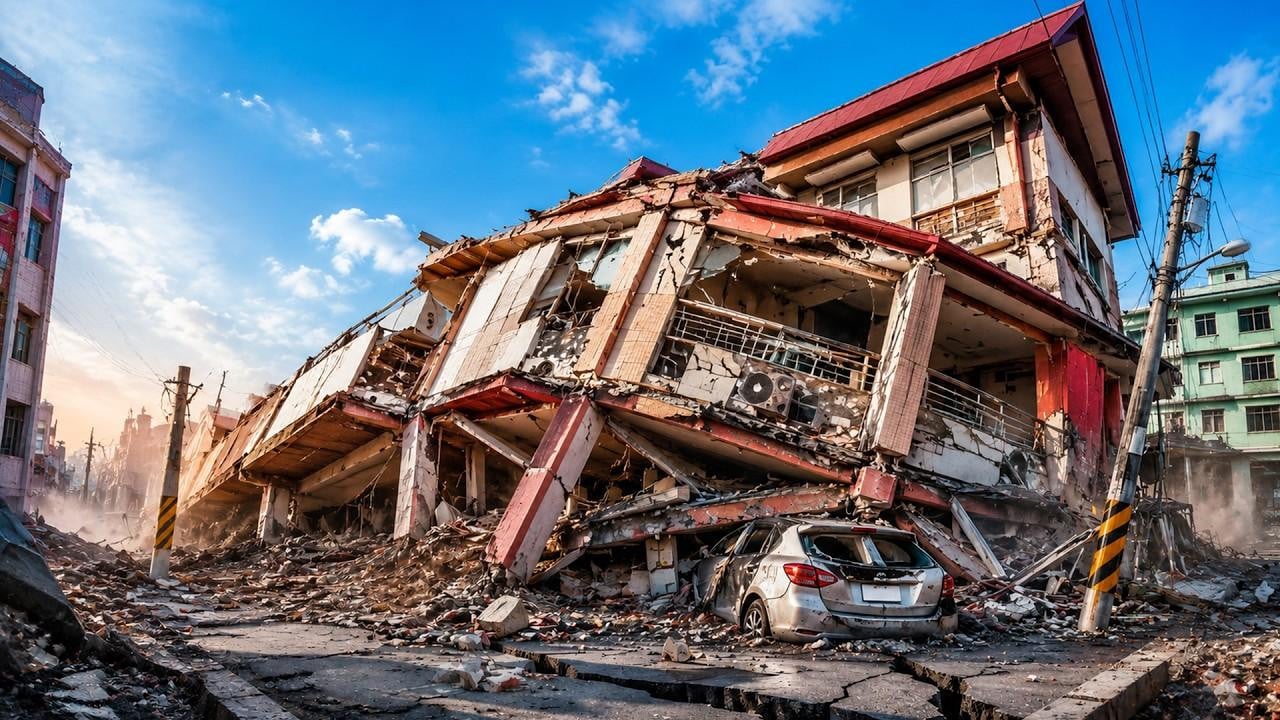
On the morning of June 8, a magnitude 7.8 earthquake struck off the coast of the Philippine island of Mindanao. According to the Philippine seismic service, the tremor was recorded at 7:37 in the morning local time, about 20 miles southwest of the city of Maasim in Sarangani Province. The hypocenter was located at a depth of about 21 miles.
A few minutes after the main shock, tsunami waves reached the shore. The highest of them, almost 5 feet, was recorded in Sarangani Province. Along other sections of Mindanao’s southern coast, waves of about 3 feet were observed. For coastal villages where some houses stand directly by the water or on stilts, that height proved dangerous. In one coastal village in Zamboanga del Sur Province, six stilt houses were damaged by the waves.
The tsunami was also recorded off the coast of the Indonesian island of Sulawesi, where the wave height reached about 2.9 inches. Tsunami waves of up to about 1 foot were also observed in Palau and Japan.
Shaking was felt across a wide area of Mindanao.
The maximum intensity, level 8 on the scale used by the Philippine seismic service, was recorded in the municipality of Malapatan in Sarangani Province. The earthquake caused especially serious damage in General Santos, a major port city with a population of about seven hundred twenty thousand people. There, the intensity of the shaking reached level 7.
In General Santos and neighboring areas, buildings, roads, bridges, communication lines, and power supply facilities were damaged. In the city, a restaurant building and a radio station building collapsed, while a shopping mall and Notre Dame of Dadiangas University sustained damage. Dangerous cracks appeared on one important bridge, and damage to communication towers complicated contact with some districts.
Transport infrastructure was also affected. Breaks and cracks appeared on roads, and General Santos International Airport was temporarily closed for safety inspections. Dozens of domestic flights were canceled, with exceptions made only for humanitarian and rescue missions.
Serious power outages also occurred. After the earthquake, eight hundred sixty-four thousand households remained without electricity, especially in the provinces of South Cotabato, Sultan Kudarat, and Davao.
The earthquake affected more than three hundred forty-six thousand people across several regions of the southern Philippines. Damage to the housing stock was also significant: more than 10 thousand homes were partially damaged, and about 2300 were completely destroyed. As a result, tens of thousands of families were left without shelter.
The earthquake coincided with the first day of the school year. Because of this, classes were disrupted for millions of schoolchildren. Authorities suspended school operations until inspections could be completed. More than eight thousand five hundred schools were affected by the earthquake, and engineers began assessing the buildings to determine where students and teachers could safely return to classrooms.
The danger did not end after the first earthquake. A powerful sequence of aftershocks began almost immediately: in less than three hours, 138 repeated seismic events were recorded, with the magnitude of some tremors reaching as high as 6.7. The repeated shocks continued to shake buildings, caused new damage, complicated rescue operations, and increased the risk of collapses and landslides.
One of the most severe situations developed in Sarangani Province. In the municipality of Glan, a large landslide came down after the underground tremors. It buried homes at the foot of a mountain. According to authorities, at least fourteen people were killed there.
According to official data as of June 11, the death toll had reached 47 people. Six hundred eighty-eight people were injured, and another 31 people were listed as missing.
The progression of disasters that we have been observing in recent years is not only an increase in the number of events appearing in news reports. It is an increase in the number of personal tragedies. Every new earthquake, flood, tornado, or eruption leaves behind people who lose their homes, their safety, and their sense of stability, and who are forced to piece their lives back together from the beginning.
Public awareness and the attention of the international community can create the conditions for an independent scientific discussion and for the consolidation of efforts at the global level. The consolidation of scientists from different countries, including climatologists, geophysicists, oceanographers, volcanologists, and specialists in other fields, is becoming not merely desirable, but necessary.
Publication of this material provides an opportunity for open discussion and does not in itself imply institutional endorsement, confirmation, or scientific verification of the views expressed. The material does not constitute an official statement, expert opinion, or professional advice.