
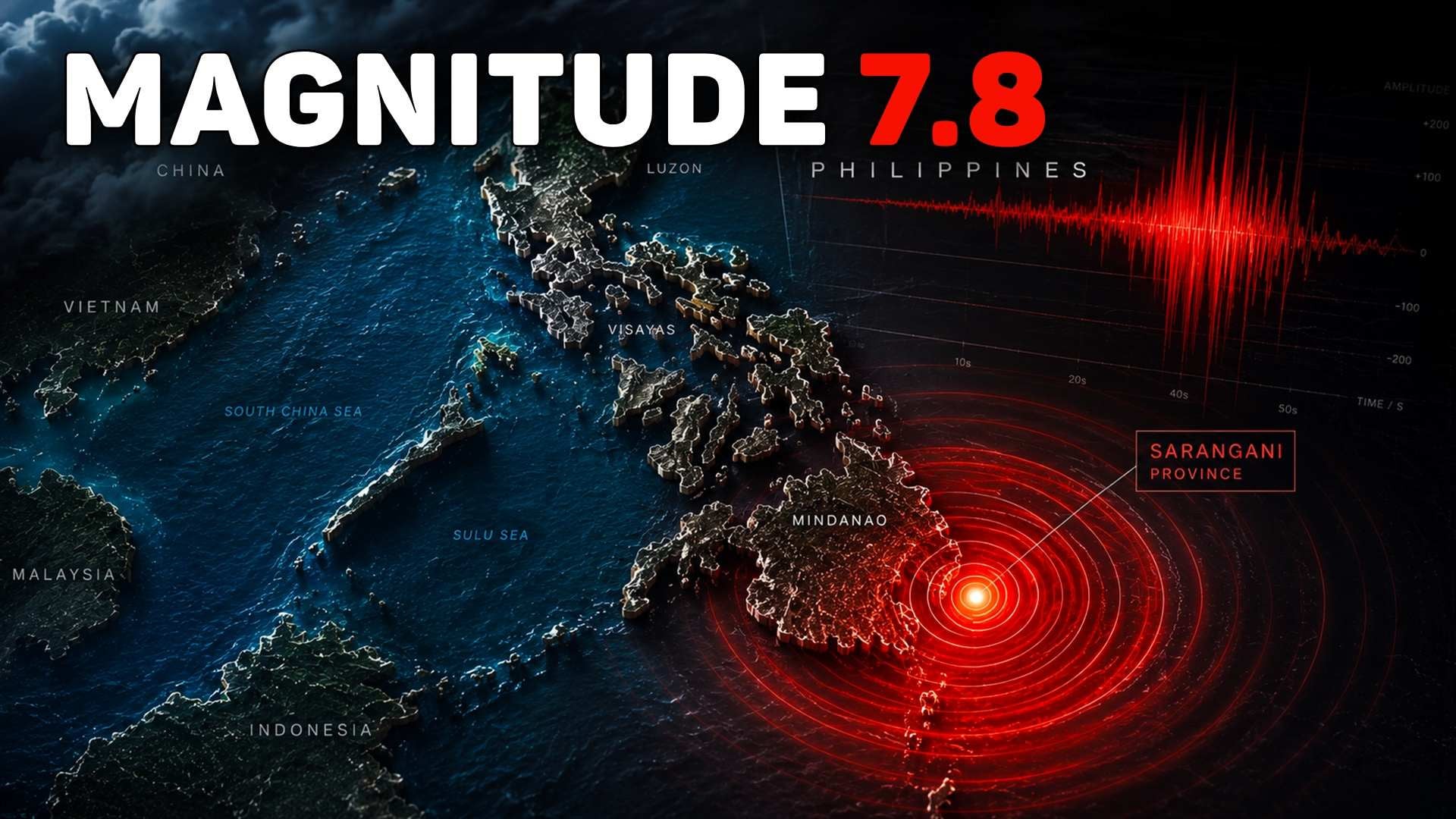
Earthquakes and volcanic activity were observed in various regions of the world over the past week. A deep-focus magnitude 6.1 earthquake in Italy with a focal depth of 259 km, a series of tremors on the Greek island of Evia, and a destructive magnitude 7.8 earthquake in the Philippines followed by a tsunami — these events allow researchers to study how processes within the Earth’s interior may be linked to changes detected in the ocean, atmosphere, and Earth’s crust. Over the past week, the Sakurajima volcano in Japan and the Shiveluch volcano in Kamchatka showed increased activity: ash plumes reached up to 12 km, and “ash rain” covered urban areas of Kagoshima.
Against this backdrop, atmospheric instability affected Europe and Asia: an EF2-category tornado in Lithuania left thousands of people without power and damaged a cemetery, a vortex passed directly through Rome in Italy, and rare tornadoes for these regions were also recorded in Bulgaria and the Netherlands. In India, storms with wind speeds of up to 100 km/h destroyed solar power plants and residential buildings. Such simultaneity of diverse phenomena — from seismic events to extreme atmospheric processes — indicates a restructuring of planetary systems. A chronicle of climate processes and geophysical activity for the period from June 1 to 8, 2026.
Time codes:
00:00 Introduction
00:18 Italy: thunderstorms, hail, and tornadoes in Rome and Milan
02:40 Lithuania: powerful EF2-category tornado in Kaunas
04:25 Bulgaria and the Netherlands: storms, flooding, and rare tornadoes
07:14 India: destructive storms in Rajasthan, damage to solar energy infrastructure
10:23 Japan: eruption of Sakurajima and “ash rain” in Kagoshima
12:07 Russia: Shiveluch volcano erupted, sending ash up to 12 km
12:45 Italy: deep-focus magnitude 6.1 earthquake in the Tyrrhenian Sea
13:53 Greece: series of earthquakes on Evia Island
14:46 Philippines: destructive magnitude 7.8 earthquake and tsunami
18:07 Conclusions: impacts of disasters and the importance of a scientific approach
The earthquake in the Philippines is a vivid example of how the consequences of a disaster do not end when the shaking stops. If a person survives, that is the most important thing. But after that, they face other challenges: where to live if their home is gone; how to feed their family; where children will go to school if it has been destroyed.
When we talk about the consequences of disasters, it is important to understand that it is not only a list of destruction. It is a multitude of human lives that are suddenly thrown out of their normal course. That is why the increasing frequency of disasters is not just a rise in the number of events in reports — it is an amplification of individual human tragedies.
Understanding the physics of these processes is key to comprehending what is happening. These changes affect everyone, and a scientific approach to studying the planet is becoming a priority for society.
Watch more materials on our channel about the true causes of escalating climate disasters and their progression based on a mathematical model:
📍 "Nanoplastics. A Threat to Life | Popular Science Film by ALLATRA"
📍 "Why Is the Ocean Warming Up So Fast? | Dr. Egon Cholakian"
Publication of this material provides an opportunity for open discussion and does not in itself imply institutional endorsement, confirmation, or scientific verification of the views expressed. The material does not constitute an official statement, expert opinion, or professional advice.