
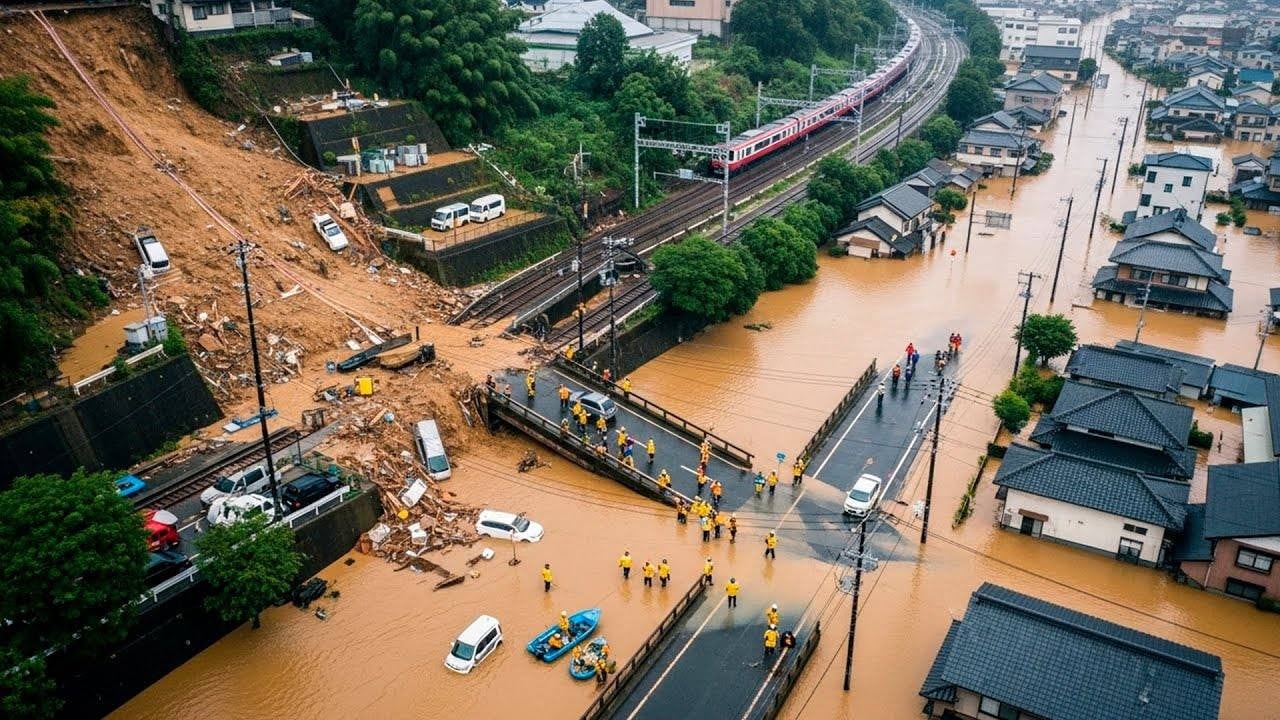
Since August 8, the Japanese island of Kyushu has been battered by severe weather. Torrential rains struck the region, triggering massive floods and landslides. The prefectures of Kumamoto, Fukuoka, Nagasaki, and Kagoshima were hit the hardest.
Rivers overflowed their banks, inundating residential areas and roads. Floodwaters destroyed bridges, damaged hundreds of homes, and paralyzed transportation. In a number of towns and villages, people were completely cut off from the outside world. More than 1,000 residents were evacuated. Train service was disrupted, with track repairs expected to take at least a week, and dozens of flights were canceled.
The situation was especially dire in the city of Kirishima, Kagoshima Prefecture. In just 12 hours, nearly 20 inches of rain fell — more than 2.5 times the monthly average for August. This set an absolute record for the entire history of meteorological observations.
Near Kirishima and Aira, 40 people, including children, were trapped in an auto-camping site after falling rocks and trees blocked the road. All were evacuated safely. On a national highway, the roadside collapsed, sending two trucks plunging into a river. Both drivers were injured and hospitalized. In Aira, a landslide destroyed a residential house with people inside — two were rescued, while one person remains missing.
On August 11, record rainfall was also recorded in Kumamoto Prefecture. In some places, more than two months’ worth of rain fell in just 12 hours.
The human toll was severe. In Yatsushiro, rescuers found a woman unconscious inside a flooded car. In the town of Kosa, a vehicle was buried by a landslide — three people were pulled out, one of them in critical condition. Three more residents are still missing after being swept away by raging floodwaters.
Natural disasters like those that struck Kyushu are occurring more frequently. And these are only outward signs of far deeper disruptions within the planet’s system.
To learn about the hidden processes that are destabilizing the biosphere and why many experts prefer to remain silent about the scale of the threat, watch the new address by Dr. Egon Cholakian.
Publication of this material provides an opportunity for open discussion and does not in itself imply institutional endorsement, confirmation, or scientific verification of the views expressed. The material does not constitute an official statement, expert opinion, or professional advice.