
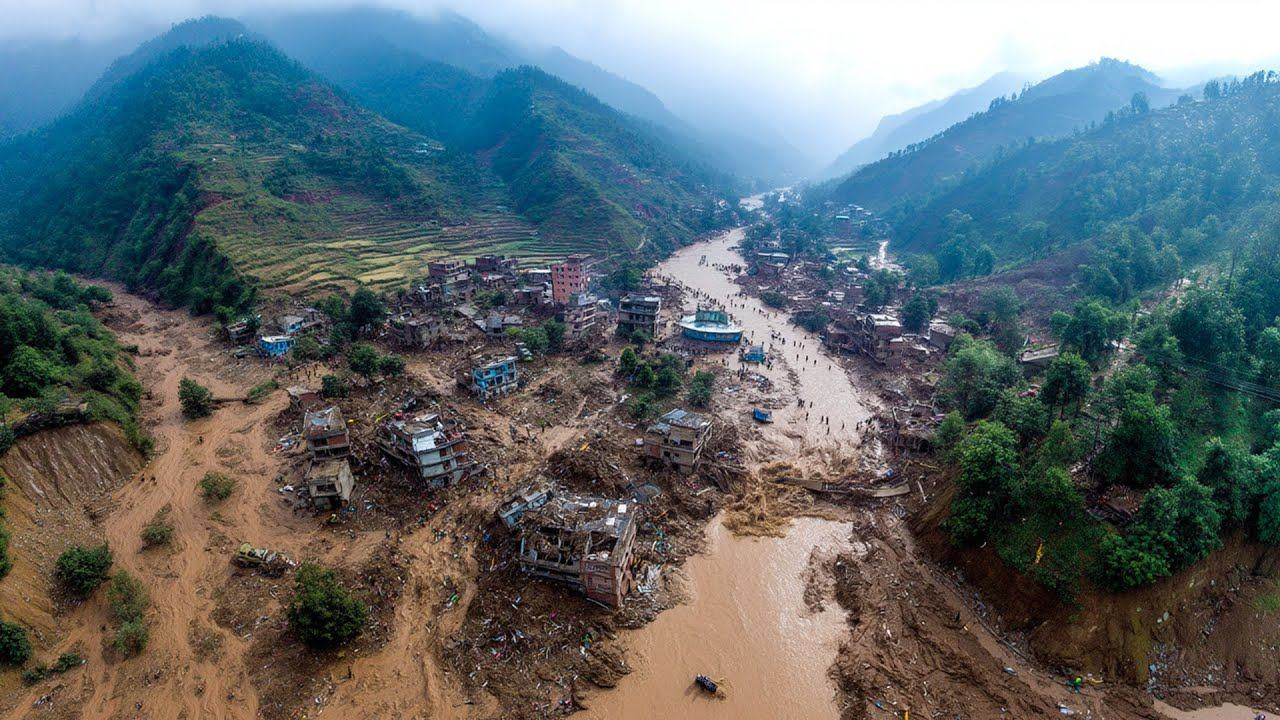
Although the monsoon season in Nepal, which usually lasts from June to September, has already ended, heavy rains once again struck the central and eastern provinces of the country on October 3rd. They caused devastating floods and landslides. The provinces of Bagmati, Madhesh, and Koshi were the most severely affected.
Water levels in eight major rivers exceeded dangerous marks. In the Koshi River, one of the largest waterways in the region, the water rose to more than twice its normal level. At the Koshi Barrage dam, a critical water flow level of over eighteen million cubic feet per second was recorded, and a state of high alert was declared. All fifty-six floodgates had to be opened instead of the usual ten to twelve, and bridge traffic was restricted to emergency services only.
Rivers that overflowed their banks flooded residential areas. Thousands of people were forced to leave their homes. More than twenty thousand police officers were deployed for rescue operations. Due to heavy rainfall and poor visibility, all domestic flights were temporarily suspended.
Major roads connecting the capital, Kathmandu, with other regions were blocked — some by landslides, others as a precautionary measure. This occurred just as hundreds of thousands of people were returning to the capital after celebrating Dashain — the country’s main festival, when residents traditionally travel to their hometowns to visit family.
In the Langtang Conservation Area, an overflowing river swept away four tourists who are now listed as missing. Landslides blocked routes to Mount Everest, and travelers were advised to use alternative trails.
In Ilam District, torrential rains triggered numerous landslides that destroyed homes and claimed the lives of at least 37 people. The disaster struck at night while residents were asleep. In the village of Ghos, a landslide buried a house, killing six members of one family.
According to experts, most of the affected areas were not previously considered high-risk zones, so the destruction came as a complete surprise.
In the southern parts of the country, lightning strikes killed three people. As of October 6, the disaster had claimed sixty lives, with eleven more people reported missing.
The heavy rains also affected neighboring countries. In Darjeeling, India, in the state of West Bengal, at least 20 people died overnight on October 6; bridges and roads were destroyed, and vast areas were flooded.
In western Bhutan, unprecedented rainfall created an emergency situation at the Tala Hydroelectric Plant — in just seven hours, the dam’s discharge rate increased more than sixfold, causing water to overflow the dam.
The world is already feeling the full force of rapidly escalating climate disasters — a reality that can no longer be denied. Scientists of the international research group ALLATRA have long warned that the scale of cataclysms will grow exponentially, and what we see today is only the beginning.
At the same time, they offer a clear path toward overcoming the climate crisis. Dr. Egon Cholakian speaks in detail about this.
The only question that remains is — will we listen in time, while there is still a chance to stop the approaching chaos?
Publication of this material provides an opportunity for open discussion and does not in itself imply institutional endorsement, confirmation, or scientific verification of the views expressed. The material does not constitute an official statement, expert opinion, or professional advice.