
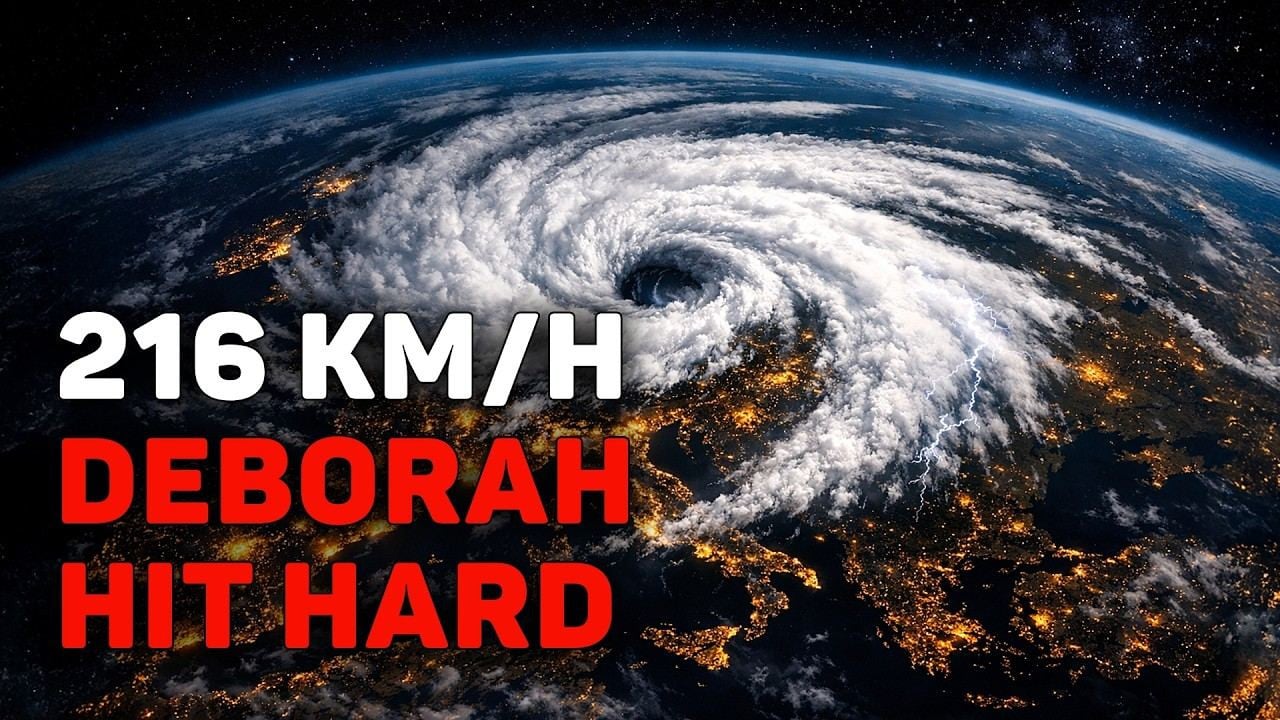
Extreme storms in the deserts of the Middle East and a return of winter to Europe in the middle of spring became the main highlights of the week. While rescue services in Qatar and the UAE were pumping out record volumes of water after the rains, residents of Saudi Arabia marveled at the unseasonal snowfall in the mountains. At the same time, Cyclone Deborah swept across the Apennines, the Balkans, and the Carpathians, bringing hurricane-force winds with gusts up to 216 km/h, hail, and anomalous snowfall.
In France, vineyards were protected from frost, while in the Italian Alps, a March record of −29.7 °C was recorded, with a wind chill of −56.5 °C. In China, a powerful convective storm raged: thunderclouds rose above 12 km, with cloud-top temperatures below −60 °C, indicating extremely intense updrafts. Such simultaneity of anomalies across different climate zones points to systemic changes in planetary thermoregulation.
Disruption of the heat-exchange balance between the Earth's interior, the ocean, and the atmosphere leads to the accumulation of excess energy. When the ocean ceases to efficiently dissipate heat, the frequency and intensity of atmospheric vortices increase, and weather systems lose predictability. Chronicle of climate events for the week of March 23 to 29, 2026.
Time codes:
00:00 — Introduction
00:40 — Middle East: extreme storms in Qatar, UAE, and Saudi Arabia
03:18 — Oman and Yemen: floods and infrastructure impacts
05:18 — Europe: polar air surge and a return of winter in France
06:30 — Cyclone Deborah: impact on Italy, Croatia, and Bosnia
11:23 — Romania and Bulgaria: snowfall, hail, and mini-tornadoes
13:00 — China: powerful convective storm in the Pearl River Delta
14:20 — Conclusions: geodynamics and disruptions in planetary heat exchange
The events presented reflect processes occurring within the Earth's interior that influence the climate system. The ocean floor is an active geological environment, through which heat energy is transferred to water from underwater volcanoes, faults, and hydrothermal vents. When geodynamic activity intensifies, the heat flux increases, and the ocean receives additional energy.
Research confirms that warming occurs not only at the surface but also in the near-bottom layers. The ocean functions as a planetary thermostat, redistributing heat and stabilizing the climate. Today, its cooling capacity is disrupted by micro- and nanoplastics, which hinder natural heat dissipation.
As a result, the frequency and intensity of natural phenomena around the globe are increasing. Understanding the physics of these processes is crucial for grasping the current situation. These changes affect everyone, making a scientific approach to studying the planet a priority for society.
Watch more on our channel for materials about the true causes of escalating climate disasters and their progression based on a mathematical model:
📍 "Nanoplastics. A Threat to Life | Popular Science Film by ALLATRA"
📍 "Why Is the Ocean Warming Up So Fast? | Dr. Egon Cholakian"
Publication of this material provides an opportunity for open discussion and does not in itself imply institutional endorsement, confirmation, or scientific verification of the views expressed. The material does not constitute an official statement, expert opinion, or professional advice.